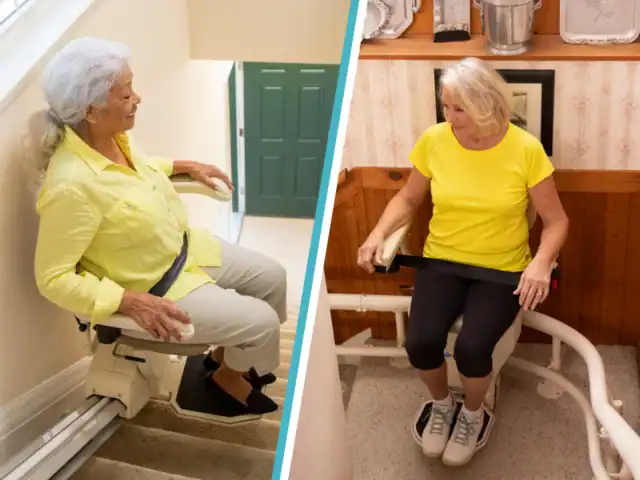
The difference between a straight and curved stairlift comes down primarily to the shape of your staircase.
A straight stairlift travels along a straight rail and is designed for a staircase that runs in one continuous line without turns or intermediate landings. A curved stairlift follows a rail configured for staircases with turns, curves, spirals, intermediate landings, or changes in direction.
In general:
- Choose a straight stairlift for one continuous, straight flight of stairs.
- Choose a curved stairlift if the stairs turn, curve, wrap around a landing, or change direction.
- A straight stairlift generally costs less and requires less customization.
- A curved stairlift generally costs more because its rail must be configured for the individual staircase.
- Both straight and curved stairlifts can provide seated access between floors when appropriately selected and installed.
The staircase determines the basic type of stairlift you need, but user weight, transfer needs, available space, indoor or outdoor placement, and preferred features also affect which model is appropriate.
Straight vs. Curved Stairlifts at a Glance
| Feature | Straight Stairlift | Curved Stairlift |
| Staircase | One continuous straight flight | Turns, curves, spirals, or intermediate landings |
| Rail | Straight | Custom-fabricated or modular |
| Customization | Generally less | More extensive |
| Typical Cost | Approximately $4,000–$5,000* | Generally starts around $9,000* |
| Installation | Typically simpler | More complex |
| Ordering/Preparation | Often faster | Varies by custom or modular rail system |
| Multiple Turns | No | Yes |
| Intermediate Landing | Generally no | Yes |
| Indoor Options | Yes | Yes |
| Outdoor Options | Yes | Available depending on model/application |
*Prices are general planning estimates. Actual stairlift pricing varies based on model, staircase, rail length, options, installation requirements, geographic location, freight, labor, permits, and dealer.
What Is a Straight Stairlift?
A straight stairlift is a motorized seat that travels along a straight rail installed on a staircase without curves, turns, or intermediate landings.
Straight stairlifts are the simplest solution for many traditional staircases because the rail follows one continuous line from the lower landing to the upper landing.
The rail attaches to brackets secured to the stair treads rather than the wall, so installing a stairlift generally does not require major structural changes to the home.
When Do You Need a Straight Stairlift?
A straight stairlift may be appropriate when:
- The staircase travels in one continuous straight line.
- There are no turns or curves.
- There are no intermediate landings where the staircase changes direction.
- The selected stairlift has adequate clearance for the staircase and user.
- An appropriate indoor or outdoor model is available for the application.
Straight stairlifts generally require less customization than curved models, which can make them more affordable and quicker to prepare for installation.
Harmar offers several straight stairlift models for different needs, including indoor, outdoor, compact, and heavy-duty applications.
What Is a Curved Stairlift?
A curved stairlift is designed for a staircase with turns, curves, spirals, intermediate landings, or other changes in direction.
Its rail follows the staircase rather than traveling along one continuous straight line.
Curved stairlifts can provide continuous seated travel across complex staircase layouts without requiring the user to transfer from one stairlift to another at a landing.
When Do You Need a Curved Stairlift?
You will generally need a curved stairlift when the staircase:
- Turns 90 or 180 degrees
- Includes an intermediate landing and changes direction
- Curves or sweeps
- Includes spiral stairs
- Has winding or pie-shaped steps
- Travels across multiple flights
- Requires the rail to continue around a corner or across a landing
A professional staircase assessment can determine whether a straight or curved rail is required.
Can a Straight Stairlift Work on Stairs With a Landing?
It depends on the staircase.
If a landing separates two flights that change direction, a curved stairlift is generally the appropriate solution for continuous travel between floors.
In some configurations, two separate straight stairlifts could potentially be installed—one on each flight. However, that would require the user to get off one stairlift, cross the landing, and transfer onto the second chair.
That may not be appropriate for someone with balance, strength, endurance, or transfer limitations.
A curved stairlift can travel around the landing without requiring an intermediate transfer.
For that reason, the user’s abilities should be considered alongside the physical staircase when comparing one curved stairlift with two straight stairlifts.
Are All Curved Stairlifts Custom-Made?
Not necessarily.
Curved stairlifts can use either custom-fabricated or modular rail systems, depending on the manufacturer and model.
Custom Curved Stairlift Rails
A custom rail is fabricated specifically to follow the measurements, angles, turns, and other characteristics of an individual staircase.
Harmar’s Helix Curved Stairlift uses a custom-fabricated rail designed for the staircase.
Modular Curved Stairlift Rails
Modular curved stairlifts use pre-fabricated rail sections that are configured to follow the staircase.
Because the individual rail components already exist, modular systems can reduce manufacturing and turnaround time compared with some fully custom-fabricated rails.
Harmar offers modular curved stairlift solutions including the Otolift Modul-Air Smart and UP Stairlift.
A dealer can evaluate the staircase and explain whether a custom or modular system is more appropriate.
Which Costs More: A Straight or Curved Stairlift?
A curved stairlift generally costs more than a straight stairlift because the rail and installation must accommodate turns, landings, and other staircase-specific characteristics.
As a broad planning estimate, a new straight stairlift may cost approximately $4,000 to $5,000.
Curved stairlifts generally start around $9,000 and can cost more depending on the staircase and selected system.
Factors affecting curved stairlift cost can include:
- Rail length
- Number of turns
- Degree of turns
- Number of landings
- Staircase complexity
- Custom or modular rail requirements
- Indoor or outdoor installation
- Powered features
- Upholstery and finish selections
- Freight
- Installation labor
- Local permits or inspections
These figures are estimates rather than guaranteed prices. A professional home assessment and itemized dealer quote provide the most accurate stairlift cost.
Which Is Faster to Install: A Straight or Curved Stairlift?
A straight stairlift can generally be prepared and installed sooner because its rail requires less customization.
Once the equipment is available, the physical installation of a straight stairlift can often be completed within a few hours, although timing varies by staircase, model, installer, and application.
Curved stairlifts require more detailed measurements and rail configuration before installation.
However, not every curved stairlift has the same turnaround time. A fully custom-fabricated rail may require additional manufacturing time, while modular curved rail systems can often be prepared more quickly.
Once the curved system arrives at the home, the actual installation may still be completed relatively quickly. Your dealer should provide separate estimates for:
- Measurement and ordering
- Manufacturing or rail preparation
- Delivery
- On-site installation
This distinction is important when comparing straight and curved stairlift timelines.
Is a Curved Stairlift Better Than Two Straight Stairlifts?
Not necessarily. The better solution depends on both the staircase and the person using the lift.
For a staircase with a landing between two straight flights, installing two straight stairlifts may sometimes cost less than installing one curved stairlift.
However, two straight stairlifts require the user to:
- Ride the first stairlift to the landing.
- Get out of the chair.
- Move across the landing.
- Transfer onto the second stairlift.
- Secure themselves again before continuing.
For someone whose mobility impairment substantially limits walking, balance, standing, or transferring, those additional transfers may undermine the purpose of installing the stairlift.
A single curved stairlift can provide continuous travel around the landing.
The right choice should therefore consider cost, staircase configuration, transfer ability, balance, strength, and long-term mobility needs.
Do Straight and Curved Stairlifts Attach to the Wall?
Generally, no.
Stairlift rails are typically supported by brackets attached to selected stair treads rather than mounted directly to the wall.
This means a stairlift can often be installed without major structural changes to the home.
The exact installation method depends on the staircase, stairlift model, rail system, and site conditions.
Can Straight and Curved Stairlifts Be Installed Outdoors?
Yes, but the stairlift must be designed and rated for outdoor use.
Outdoor stairlifts use materials and protective features intended for exposure to changing temperatures, moisture, and other environmental conditions.
Harmar offers straight and curved stairlift solutions for compatible outdoor applications.
An indoor stairlift should not simply be installed outside.
What Else Should You Consider Besides the Shape of the Stairs?
The staircase determines whether you need a straight or curved rail, but it does not determine the entire stairlift.
You should also consider:
User Weight and Dimensions
The selected stairlift must provide appropriate weight capacity, seat dimensions, armrest spacing, footrest space, and clearance for the user.
Transfer Ability
Consider how easily the user can sit down, stand up, turn, and transfer at both landings.
A swivel seat can help position the user away from the staircase when getting on or off the lift.
Staircase Width
The staircase needs enough room for the stairlift and user while maintaining appropriate clearance.
Folding seats, armrests, footrests, and rails can help preserve staircase space when the lift is not in use.
Indoor or Outdoor Placement
Outdoor applications require stairlifts specifically designed for exterior environments.
Weight Capacity
Harmar offers stairlifts with different capacities, including heavy-duty options for users who need additional weight capacity and seating space.
Doorways and Walkways
If the bottom of the stairlift rail would obstruct a doorway or walkway, a folding rail may be appropriate on compatible models.
Long-Term Mobility Needs
Consider not only what the user can comfortably do today, but also whether transfers, balance, strength, or endurance are likely to affect how the stairlift will be used over time.
How Do I Know Whether I Need a Straight or Curved Stairlift?
Start with one question:
Does your staircase travel in one continuous straight line from the bottom landing to the top landing?
If yes, a straight stairlift may be appropriate.
If no—because the staircase turns, curves, spirals, or changes direction across a landing—you will generally need a curved stairlift for continuous travel.
Then consider:
- Indoor or outdoor installation
- User weight and body dimensions
- Staircase width
- Transfer ability
- Available landing space
- Desired features
- Budget
- Long-term mobility needs
A professional stairlift assessment can confirm which rail type and stairlift models are compatible with the home and user.
Straight or Curved? Find the Right Stairlift for Your Home
For most homes, choosing between a straight and curved stairlift begins with the staircase itself.
Straight staircase with no turns? Start with straight stairlift options.
Turns, curves, or intermediate landings? Compare curved stairlift solutions.
From there, a qualified stairlift dealer can measure the staircase, assess the upper and lower landings, discuss the user’s mobility and transfer needs, and recommend compatible models and features.
Harmar offers straight, curved, indoor, outdoor, compact, and heavy-duty stairlift options for a wide range of homes and mobility needs.
Frequently Asked Questions About Straight vs. Curved Stairlifts
What is the main difference between a straight and curved stairlift?
A straight stairlift uses a straight rail for a staircase without turns or intermediate landings. A curved stairlift follows a rail configured for staircases with curves, turns, landings, or changes in direction.
Is a curved stairlift more expensive than a straight stairlift?
Generally, yes. Curved stairlifts typically cost more because their rails require additional measurement, configuration, manufacturing, and installation planning.
Can a straight stairlift go around a corner?
No. A straight stairlift travels along one straight rail. A staircase that turns or curves generally requires a curved stairlift for continuous travel.
Can a stairlift go around a landing?
Yes. A curved stairlift can be configured to travel around an intermediate landing and continue onto another flight of stairs.
Can I use two straight stairlifts instead of one curved stairlift?
Sometimes, depending on the staircase. However, two straight stairlifts require the user to transfer between chairs at the landing. A single curved stairlift allows continuous seated travel, which may be more appropriate for users with limited balance, strength, walking ability, or transfer ability.
How much does a curved stairlift cost compared with a straight stairlift?
As a broad planning estimate, new straight stairlifts may cost approximately $4,000 to $5,000, while curved stairlifts generally start around $9,000. Actual pricing depends on the staircase, rail, model, features, installation, and local dealer.
Are curved stairlifts custom-made?
Some are. Curved stairlifts may use either custom-fabricated rails designed specifically for the staircase or modular rail sections configured to follow its shape.
Do stairlifts attach to the wall?
Stairlift rails are generally attached to brackets secured to the stair treads rather than the wall, so installation typically does not require major structural changes.
Are You Ready to Learn More?
Are you interested in learning more about which stairlift type might be best for you? Visit our Dealer Locator to connect with a Harmar-certified dealer in your area for a free consultation today!