

Resources
Stairlift Guide
Whether you are researching a stairlift for yourself or helping a loved one, this stairlift buyer’s guide can help you understand your options and prepare for the purchasing process.
Learn how stairlifts work, compare straight and curved stairlifts, explore common features and costs, understand the installation process, and find out what to expect after your lift is installed. You will also learn who may benefit from a stairlift and which questions to ask before choosing a model or local dealer.
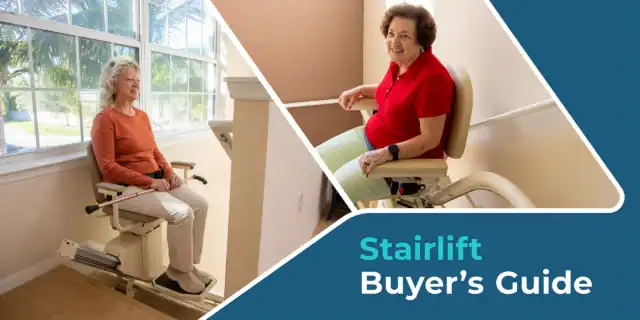
Basics of Stairlifts:
Everything You Need to Know to Get Started
A stairlift provides seated access between floors for a person whose permanent or chronic mobility impairment makes climbing stairs substantially difficult or unsafe. Choosing the right stairlift depends on the shape of the staircase, whether the lift will be installed indoors or outdoors, the user’s mobility and transfer needs, available space, weight capacity, and preferred features.
A stairlift, sometimes called a chair lift for stairs, is a motorized seat that travels along a rail attached to a staircase. It allows a seated user to move between floors without walking up or down the stairs.
Stairlifts can be installed on straight, curved, or outdoor staircases. The user sits in the chair, secures the seat belt, and operates the lift using a control on the armrest. Call/send controls can also move the empty chair to the opposite end of the staircase.
Because stairlifts attach to the stair treads rather than the wall, they can be installed in many existing homes without major structural changes.
Stairlift Components
The two primary components of a stairlift are the rail and the chair. The lift also includes a drive system, controls, safety features, and, on battery-powered models, a charging system.
The Rail
The stairlift rail is secured to brackets installed on the stair treads. Its design depends on the shape and location of the staircase.
A straight rail is designed for a staircase that travels in one continuous line. A curved rail follows turns, intermediate landings, spirals, or changes in direction.
Some stairlift rails can extend beyond the staircase so the user can enter or exit away from the top step. A folding rail may be used at the lower landing when a full-length rail would obstruct a doorway, hallway, or frequently used walkway.
Harmar’s Pinnacle stairlifts use a nylon polymer gear rack and helical worm gear drive system. This design does not require grease or lubrication on the rail, helping simplify cleaning and routine care.
The Chair
The chair carries the user along the staircase. Depending on the stairlift model, it may include a padded seat, armrests, a footrest, a seat belt, and a swivel seat that helps the user enter or exit at a landing.
Many stairlift seats, armrests, and footrests fold when the lift is not in use. This reduces the lift’s footprint and leaves more room for other people to use the staircase.
Available features vary by model and may include:
- Manual or powered swivel seats
- Manual or automatic folding footrests
- Retractable seat belts
- Call/send controls
- Key locks
- Folding rails
- Obstruction sensors
- Different seat sizes or upholstery options
Weight capacity also varies. Harmar offers stairlifts for a range of users, including the Pinnacle SL600HD, which has a weight capacity of up to 600 pounds.
To choose the right stairlift, begin with four questions:
- Is the staircase straight, curved, or divided by a landing?
- Will the stairlift be installed indoors or outdoors?
- What weight capacity and seat dimensions does the user need?
- Can the user transfer onto and off the seat comfortably?
The answers help determine the appropriate rail, stairlift model, features, and installation plan.
A local stairlift dealer should measure the staircase, assess the upper and lower landings, discuss the user’s needs, and recommend compatible options.
Straight Stairlifts
A straight stairlift is designed for a staircase that runs in one continuous line without curves, turns, or intermediate landings.
Straight stairlifts typically require less customization than curved models. Because rails can be cut or configured for the staircase, dealers may be able to keep straight stairlifts in stock and install them relatively quickly. Actual availability and installation timing depend on the dealer and selected model.
Harmar offers multiple straight stairlift options, including:
Each model is designed for different needs, including indoor or outdoor placement, user weight, seat size, available staircase space, comfort, and optional features.
Curved Stairlifts
A curved stairlift is typically needed when a staircase has turns, curves, spirals, sweeps, or intermediate landings.
The rail must follow the shape and angle of the staircase. Depending on the model, it may be custom fabricated or assembled from modular rail sections. Because curved staircase configurations require more detailed measurements and planning, curved stairlifts generally cost more than straight stairlifts.
Harmar offers two curved-staircase solutions:
- The Helix Curved Stairlift features a custom-fabricated rail designed to fit the staircase.
- The Otolift Modul-Air Smart uses a series of pre-fabricated rail pieces used to quickly build a custom curved stairlift, with a turnaround time of two weeks or less.
- The UP Stairlift uses a modular rail system that can be configured for many curved or multi-landing staircases, with a turnaround time of within a week.
A dealer can evaluate the staircase and explain which curved stairlift system is most appropriate for the home.
Stairlift Considerations
No matter which type of stairlift you choose, compare the following factors.
Ease of Use
Ask:
- Is the armrest control comfortable for the user to reach and operate?
- Are call/send controls included?
- Can the user enter and exit the chair comfortably?
- Does the seat swivel at the upper landing?
- Do the seat, armrests, and footrest fold?
- Would powered folding or swiveling features make the lift easier to use?
- Is a folding rail needed to keep a doorway or walkway clear?
Whenever possible, the person who will use the stairlift should participate in the assessment and product selection.
Safety:
- Stairlift safety features vary by model but may include:
- Seat belts
- Swivel-seat interlocks
- Overspeed brakes
- Footrest or chassis obstruction sensors
- Audible alerts
- Call/send controls
- Key locks
- Manual lowering tools
- Battery-powered operation
Ask the dealer which features are standard, which are optional, and how each one works.
A stairlift can reduce the need to climb stairs, but it does not eliminate every fall risk. The user must still be able to transfer onto and off the chair safely or have appropriate assistance.
Weight capacity:
Choose a stairlift with a rated weight capacity that comfortably accommodates the user. Do not select a model based only on the maximum weight listed; seat width, seat depth, armrest spacing, footrest size, and the user’s ability to transfer are also important.
Harmar stairlift capacities vary by model and include heavy-duty options with a capacity of up to 600 pounds.
Warranty:
Review the manufacturer’s warranty before purchasing a stairlift. Coverage may differ for parts, batteries, gear racks, labor, and service calls.
Ask the dealer:
- Which components are covered?
- How long does each type of coverage last?
- Is labor included?
- Who completes warranty repairs?
- Are travel or service-call charges covered?
- Does the warranty require scheduled maintenance?
- Is the warranty transferable to a new owner?
Request the warranty terms in writing before making a final decision.
Other Factors to Consider – Why You Should Find A Local Dealer
A local stairlift dealer can assess the staircase, recommend compatible equipment, complete the installation, provide user training, and respond when service is needed.
Proximity matters because the installing dealer is often the first person to contact for maintenance, troubleshooting, repairs, and warranty support.
When comparing dealers, consider:
- Experience with the stairlift brand
- Manufacturer or factory training
- Licensing and insurance, where required
- Customer reviews
- Installation availability
- Labor and service warranties
- Response time for service calls
- Maintenance options
- Written, itemized pricing
Harmar’s grease-free stairlift drive system may help simplify routine rail care, but the lift should still be inspected and serviced according to the owner’s manual, dealer recommendations, and frequency of use.
Request the warranty terms in writing before making a final decision.
Stairlifts, whether curved, straight, inside, or outside, can be fantastic accessibility solutions to help you or a loved one remain at home longer with improved independence.
Anyone who is looking to…
…should consider learning more about the benefits of installing a chair lift.
Others Who May be Stairlift Candidates:
Stairlifts are commonly used by people who can sit and transfer onto a chair but find climbing stairs difficult, tiring, painful, or unsafe.
A stairlift may be considered by someone who wants to:
- Age in place
- Have mobility challenges
- Continue using every level of the home
- Return home after a hospital or rehabilitation stay
- Reduce physical strain from climbing stairs
- Remain in a familiar home rather than relocate
A stairlift may also assist caregivers by reducing the need to physically support someone while they climb the stairs.
How to Choose the Best Stairlift Company for Your Needs
The best stairlift company for your needs should offer appropriate equipment, qualified installation, clear pricing, product training, warranty support, and dependable local service.
Research both the stairlift manufacturer and the installing dealer. The manufacturer determines the product’s design, available features, specifications, and product warranty. The dealer typically handles the home assessment, quote, installation, training, maintenance, and repair service.
Choose a dealer who asks detailed questions about the staircase, user, caregivers, home, and expected length of use.
The dealer should evaluate factors such as:
- Staircase shape, width, length, and incline
- Available space at each landing
- Nearby doors and walkways
- User height and weight
- Seat and footrest dimensions
- Transfer ability
- Indoor or outdoor placement
- Desired features
- Electrical and charging requirements
- Local codes or permit requirements, when applicable
Ask whether the installation team is trained to install and service the specific brand and model being recommended. Licensing and insurance requirements differ by location, so verify which credentials apply in your area.
It can be helpful to compare assessments and written quotes from more than one local dealer.
Read reviews for both the stairlift dealer and the manufacturer. Look beyond the overall star rating and pay attention to comments about:
- Communication
- Installation quality
- Respect for the home
- User training
- Pricing transparency
- Service response times
- Warranty support
- Long-term reliability
Review sources may include Google, the Better Business Bureau, and other established consumer-review platforms.
If you are working with an occupational therapist, physical therapist, case manager, hospital discharge planner, or aging-in-place specialist, ask whether they can suggest local accessibility providers. They may also help identify features that support the user’s specific needs.
Stairlift installation depends on the type of staircase, rail system, selected model, customization, product availability, and local requirements.
Straight stairlifts can often be installed more quickly because the rail does not need to follow curves or turns. Curved stairlifts require a rail configuration designed for the specific staircase, which may increase measuring, ordering, fabrication, and installation time.
Before purchasing, ask the dealer to explain:
- How the staircase will be measured
- Where the rail will begin and end
- How much walking space will remain
- Whether a folding rail is needed
- Where the lift will charge
- What installation work is included
- How long ordering and installation may take
- Whether permits or inspections apply
- What training is provided
- Who to contact for service
After installation, the technician should test the lift and show the user and caregiver how to operate it, charge it, swivel and fold the seat, use the seat belt, identify alerts, and respond to basic operating issues.
- Will you assess both the user’s needs and the staircase before recommending a product?
- Will you visit the home and take measurements before the equipment is ordered?
- Why are you recommending this specific stairlift model?
- Is the model appropriate for the user’s height, weight, mobility, and transfer needs?
- Which features are standard, and which cost extra?
- Are your installers trained or certified by the manufacturer?
- Do you employ your own installers or use subcontractors?
- Are you licensed and insured as required in this area?
- What product, parts, battery, labor, and installation warranties are included?
- Who handles warranty claims?
- What does a service call cost?
- How quickly do you typically respond to service requests?
- Do you provide ongoing maintenance?
- Do you offer stairlift rentals?
- Do you install used or refurbished stairlifts?
- Is the recommended model currently in stock?
- What is the expected ordering and installation timeline?
- Does the written quote include the lift, options, freight, installation, training, permits, and taxes?
- Do you offer financing or provide information about assistance programs?
- Can the stairlift be removed, relocated, traded in, or bought back later?
Personal recommendations can provide a helpful starting point, but every staircase and user is different. A dealer that was right for one household may not offer the best product or service arrangement for another.
Compare written quotes carefully. Confirm that each quote includes the same basic information so you are comparing equivalent products and services.
Do not evaluate a dealer based only on price. A low initial quote may not include freight, installation, optional equipment, permits, maintenance, or future service calls.
It may also be helpful to request:
- Product literature
- Warranty documents
- Stairlift dimensions
- A showroom demonstration
- Photos of similar installations
- Customer references, when available
- Written service policies
- An estimated project timeline
Reviews do not need to be uniformly perfect for a dealer to be credible. Look for consistent patterns and note how the company responds when customers report a problem.
Look for a stairlift professional who understands both the equipment and the needs of people aging in place.
Relevant training may include factory or manufacturer certification, accessibility-product installation experience, and Certified Aging-in-Place Specialist education. However, a professional designation should not replace model-specific installation training.
Ask who will measure the stairs, who will install the equipment, and whether those individuals have current experience with the exact stairlift being recommended.
If possible, visit a showroom and try the stairlift. Evaluate:
- Seat comfort and dimensions
- Armrest position
- Footrest size
- Control placement
- Swivel operation
- Folding components
- Entry and exit movement
- Ride comfort
- Clearance on the staircase
After selecting a model, ask the dealer to explain its safety features and demonstrate why the lift may stop. Obstruction sensors, an unlatched swivel seat, an improperly parked chair, or an interrupted charging connection may prevent normal operation. Learn basic troubleshooting, but do not attempt mechanical or electrical repairs yourself. Contact the dealer when the lift requires service.
After installation, the technician should test the stairlift and provide operating instructions for the user and caregiver.
Training should cover:
- Starting and stopping the lift
- Using the seat belt
- Swiveling and locking the seat
- Folding the seat, armrests, footrest, or rail
- Using call/send controls
- Parking the lift at a charging location
- Understanding audible or visual alerts
- Responding to an obstruction
- Using any emergency or manual-lowering feature
- Contacting the dealer for assistance
Keep the owner’s manual, warranty documents, dealer contact information, and service records together in an accessible location.
Straight and Curved Stairlift Pricing
Stairlift prices vary based on the staircase, rail type, model, options, installation requirements, geographic location, and dealer.
A home assessment and itemized dealer quote provide the most reliable estimate.
A straight stairlift generally costs less than a curved stairlift because its rail is simpler and requires less customization. As a broad planning estimate, a new straight stairlift may cost approximately $4,000 to $5,000, although actual prices can fall outside this range.
Curved stairlifts generally start around $9,000 and may cost more depending on:
- Rail length
- Number and degree of turns
- Intermediate landings
- Staircase complexity
- Custom or modular rail requirements
- Indoor or outdoor installation
- Powered features
- Upholstery or finish selections
- Freight
- Labor
- Local permit or inspection requirements
Pricing changes over time and varies by dealer, so these figures should not be treated as guaranteed quotes.
Ask for an itemized estimate showing:
- Future service or maintenance costs
- Stairlift and rail
- Optional features
- Freight or delivery
- Installation
- Permits or inspections
- Taxes
- Training
- Warranty coverage
Original Medicare generally does not cover stairlifts because they are typically treated as home modifications rather than covered durable medical equipment. However, coverage and financial assistance vary by program and individual circumstances.
Potential resources may include:
- Medicaid home- and community-based services waivers
- Department of Veterans Affairs benefits or grants
- State assistive-technology programs
- Area Agencies on Aging
- Nonprofit home-modification programs
- Local housing or community-development programs
- Long-term care insurance
- Workers’ compensation
- Manufacturer or dealer financing
Eligibility and available benefits vary by state, program, diagnosis, income, service history, and insurance plan. Contact the program or insurer directly before assuming a stairlift will or will not be covered.
A stairlift may help a person continue using multiple levels of the home without relocating solely because the stairs have become difficult.
It may also reduce exposure to one common household challenge: repeatedly climbing and descending a staircase with limited strength, endurance, or balance.
However, savings cannot be guaranteed. The financial value of a stairlift depends on the person’s needs, length of use, alternative home modifications, caregiving requirements, housing costs, and available assistance.
When comparing options, consider the stairlift’s total cost alongside:
- Other accessibility equipment
- Moving expenses
- Renovation costs
- Caregiver support
- First-floor living modifications
- Short- or long-term residential care
Stairlift Installation:
What to Expect
Professional stairlift installation generally includes measuring the staircase, securing the rail to selected stair treads, installing the carriage and chair, connecting or activating the charging system, testing the lift, and training the user.
Harmar’s LiftSquad-trained dealers complete product training related to Harmar equipment and installation. Ask your local dealer whether the technician assigned to your home is LiftSquad-trained and experienced with your selected model.
Installation Time
Straight stairlifts can often be installed more quickly than curved models because the rail follows one continuous line and usually requires less customization.
Actual installation time depends on the staircase, model, rail length, folding-rail requirements, electrical access, local requirements, and installation team. Your dealer should provide an estimated timeline before installation day.
Day of Installation
The installation team will confirm the staircase measurements and review the planned rail position.
Brackets are then secured to selected stair treads. A stairlift does not normally need to be attached to every step, and the rail is generally mounted to the stairs rather than the wall.
The installer will assemble or size the rail, attach the carriage and chair, establish the charging connection, and check clearance from walls, handrails, doors, and surrounding walkways.
Installation methods differ by product, so the exact process may vary from one stairlift model to another.
Folding Rail Applications
A folding rail may be recommended when the lower portion of the rail would obstruct a doorway, hallway, or walking path.
Depending on the selected manufacturer, the rail may fold manually or automatically. The technician will install and test the folding mechanism and demonstrate how to operate it.
Testing Your Lift
Before completing the installation, the technician should test the stairlift through its full travel path and confirm that the controls, charging system, swivel seat, folding components, and safety sensors operate properly.
The installer should then train the user and caregiver and remain available for questions until they understand the stairlift’s basic operation.
Before Installation
Curved stairlift installation begins with a detailed measurement of the staircase. The dealer may use manual measurements, a photographic survey, or a digital measuring system, depending on the product.
The rail is then custom fabricated or configured from modular sections to follow the staircase.
Ordering time and installation time depend on the selected system, rail complexity, product availability, and dealer schedule.
Day of Installation
The installation team will compare the rail or installation plan with the staircase and position the rail supports as specified for the product.
The rail sections are assembled or positioned, secured to the stairs, and checked for alignment. The carriage, seat, batteries, and other components are then installed.
The team will test the stairlift throughout the entire rail path, including curves, landings, stopping points, and charging locations.
As with straight stairlifts, the rail is normally secured to selected stair treads rather than attached directly to the wall.
Chair Lift Checklists
Before turning the stairlift over to the customer, the installer should complete a final inspection and operating checklist.
This may include checking:
- User and caregiver training
- Rail and bracket security
- Seat and armrest position
- Seat belt operation
- Swivel-seat interlock
- Footrest and carriage sensors
- Charging locations
- Call/send controls
- Folding components
- Emergency or manual-lowering features
- Clearance around the lift
Learn More About Curved Stairlifts
Harmar offers curved stairlift solutions for staircases with turns, bends, spirals, sweeps, or intermediate landings.
The Helix Curved Stairlift uses a custom-fabricated rail designed for the home’s staircase. The UP Stairlift uses a modular rail system that can be configured for many staircase layouts.
A Harmar dealer can measure the stairs, compare the available systems, and recommend the appropriate model based on the staircase, user, home, timing, and preferred features.
Keep the dealer’s contact information after installation. The dealer will typically be your primary resource for maintenance, troubleshooting, warranty assistance, and repairs.
After Installation
Once the stairlift has been installed, proper use, charging, cleaning, and professional service can help support dependable performance.
Follow the instructions in the owner’s manual and contact the installing dealer if the lift begins operating differently, displays an error, makes an unfamiliar sound, or shows visible wear.
Schedule stairlift service according to the manufacturer’s instructions and your dealer’s recommendations. Many owners arrange an annual professional inspection, although more frequent attention may be appropriate for heavily used lifts or when operating issues appear.
Regular service may include checking:
- Rail and mounting hardware
- Batteries and charging contacts
- Seat and swivel operation
- Armrests and footrest
- Controls and call/send devices
- Seat belt
- Safety sensors
- Folding-rail mechanisms
- General operation and ride quality
Do not attempt to modify or repair the stairlift unless the owner’s manual specifically authorizes the action.
Cleaning Your Stairlift
Dust the chair, footrest, and exposed rail surfaces periodically using the cleaning method recommended in the owner’s manual.
Harmar’s Pinnacle drive system does not require grease or lubrication on the rail. Do not apply oils, grease, household lubricants, solvents, or abrasive cleaners unless instructed by the manufacturer or dealer.
For model-specific cleaning guidance, refer to the owner’s manual or contact your Harmar dealer.
Optimizing Your Stairlift’s Battery
Many stairlifts operate using rechargeable batteries. When household electricity is available, the stairlift’s charging system keeps the batteries charged. If power is interrupted, a charged battery may allow a limited number of trips, depending on the model, battery condition, load, staircase, and outage length.
To support battery performance:
- Park the chair at a designated charging location.
- Keep the stairlift plugged in unless the owner’s manual or dealer instructs otherwise.
- Confirm that the power supply has not been disconnected.
- Use the stairlift regularly.
- Pay attention to charging alerts or unfamiliar beeping.
- Contact the dealer if the lift stops charging or loses power quickly.
- Follow the manufacturer’s instructions before an extended absence or outage.
Battery life varies. Ask the dealer how often the batteries typically need replacement and whether battery coverage is included in the warranty.
Maintain Your Independence
A stairlift can help a person continue accessing different levels of the home when climbing stairs becomes difficult. For many households, it offers a less disruptive alternative to relocating or completing major renovations.
The right stairlift depends on both the user and the home. Consider the staircase shape, indoor or outdoor placement, weight capacity, seat dimensions, transfer needs, available features, installation support, warranty, maintenance, and total cost.
A professional home assessment is the best way to confirm which stairlift fits your needs and staircase.

Consult With Us
Consult with a trusted Harmar representative to learn more about mobility and access solutions to ensure you find the right fit.