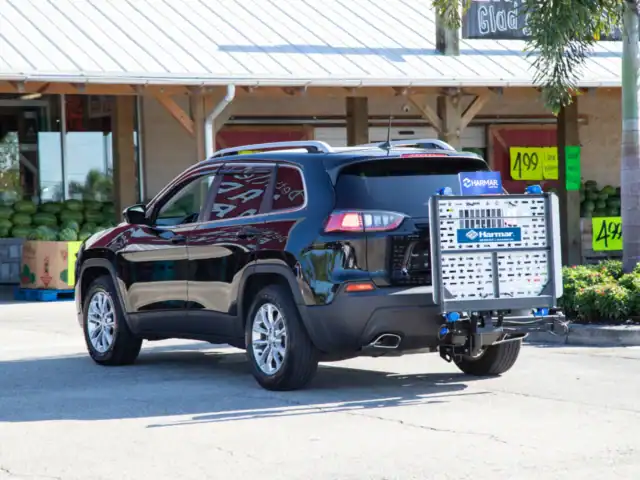
A vehicle lift is equipment installed inside a vehicle or attached to its exterior to load, secure, and transport a compatible mobility device. Instead of requiring someone to lift a wheelchair or disassemble a scooter by hand, the lift performs some or all of the physical work.
Depending on the model, a vehicle lift may use a powered platform, hoist arm, ramp, manual carrier, or hybrid mechanism. Some lifts carry the device on a hitch-mounted platform outside the vehicle. Others place it in the trunk, cargo area, or truck bed, where it is protected from weather and road debris.
These lifts transport the mobility device without its rider. They are different from wheelchair-accessible vehicle ramps or occupied platform lifts that allow a person to enter the vehicle while seated in a wheelchair. A consumer should decide which transportation problem needs to be solved before comparing equipment.
Who Benefits From a Vehicle Lift?
A vehicle lift may help anyone who uses a mobility device and wants more practical access to transportation. Common users include:
- Manual wheelchair users who cannot safely lift a folded chair into a trunk
- Power wheelchair users whose devices are too heavy for manual loading
- Mobility scooter users who want their scooter available beyond its normal travel range
- Older adults preserving community access while aging in place
- Veterans who use wheelchairs, power chairs, or scooters
- Caregivers seeking to reduce repetitive lifting, bending, and injury risk
- People with temporary or progressive mobility limitations
- Families coordinating transportation for appointments, errands, work, worship, recreation, and travel
The benefit is not only transportation of equipment. A well-matched lift can support healthcare access, social connection, work, volunteering, and the freedom to make ordinary plans without turning every trip into a loading project.
Understanding the Different Types of Vehicle Lifts
Vehicle lift terminology can overlap. “Inside” and “outside” describe where the device travels, while “platform,” “hoist,” and “hybrid” describe how it is loaded. The major vehicle lift types include:
| Type | How it loads | Storage location | Common fit |
| Hitch-mounted platform | Device rolls or drives onto a rear platform; powered models raise and fold | Outside | Scooters, power chairs, or manual chairs, depending on model |
| Manual carrier | Uses a ramp, tilt, or manual lifting arrangement | Usually outside | Certain lightweight manual chairs or compact devices |
| Hoist lift | Powered arm lifts the device; operator guides it through the opening | Inside trunk, cargo area, or truck bed | Manual chairs and compatible scooters or power chairs |
| Hybrid platform | Platform loads outside, then retracts the device into the cargo area | Inside | Compatible scooters and power chairs in larger cargo areas |
| Specialty lift | Application-specific design for RVs, trucks, micro devices, or other needs | Varies | Less common vehicle-and-device combinations |
Inside Vehicle Lifts
Inside vehicle lifts transport the wheelchair, power chair, or scooter in a trunk, SUV or van cargo area, or pickup-truck bed. Hoist and hybrid lifts are the most common inside solutions.
The primary advantages are protection and security. The mobility device is less exposed to rain, snow, sun, road salt, dust, and flying debris. It may also be less visible when the vehicle is parked. Inside storage does not add an exterior platform to the rear of the vehicle and may preserve use of cameras or sensors, depending on the application.
The trade-off is space and loading geometry. The cargo opening must be large enough for the device and the complete motion of the lift. A hoist operator may need to attach a lifting device, stand, bend, guide the suspended equipment, rotate it, or fold components. Hybrid platforms simplify drive-on or roll-on loading but occupy more cargo room. Some installations require drilling or approved mounting hardware in the cargo floor or truck bed.
Outside Vehicle Lifts
Outside vehicle lifts typically mount to a receiver hitch and carry the device on a platform or carrier behind the vehicle. They preserve interior seating and cargo space and can be among the most direct ways to load a scooter or power chair. Powered models may lift and fold with a switch or control, while manual carriers require greater physical effort.
Because the device travels outside, it is exposed to weather and road debris. An approved cover may help in some applications, but it must not interfere with securement, lights, visibility, or safe transport. The platform also adds rear length and can affect parking, garage clearance, departure angle, backup-camera view, sensors, license-plate visibility, or access to the liftgate. Swing-away options may improve cargo access when approved for the complete setup.
The hitch and vehicle must support the installed lift, mobility device, adapters, and accessories. A hitch receiver that physically accepts the lift does not automatically have adequate tongue-weight capacity.
Vehicle Lift Compatibility
Compatibility is the central buying requirement. A lift must work with the exact mobility device and the exact vehicle—not merely with “an SUV” or “a scooter.” Year, make, model, trim, hitch, drivetrain, cargo layout, and aftermarket equipment can change the answer.
A complete compatibility review considers:
- Vehicle manufacturer ratings and available payload
- Hitch class, receiver size, tongue-weight rating, and approved adapters
- Lift capacity and installed weight
- Mobility device weight in its full transport configuration
- Platform dimensions, wheelbase, wheel position, ground clearance, and center of gravity
- Cargo opening width and height, interior depth, floor strength, and loading path
- Rear suspension height, ground clearance, slopes, curbs, and driveway transitions
- Liftgate, tailgate, doors, third-row seating, cameras, sensors, lights, and license plate
- Electrical requirements and approved connection method
- Securement equipment, docking hardware, straps, retractors, or lifting points
Planning formula: Installed lift + mobility device + approved accessories and adapters = total load the relevant vehicle and mounting system must safely accommodate.
Harmar’s Vehicle Compatibility Calculator uses the vehicle and mobility-device make and model to narrow compatible lifts. Harmar states that calculator results are a guide and recommends confirmation with a representative or dealer before ordering because vehicle, device, and hitch information changes over time.
Matching the Lift to Your Mobility Device
Begin with the device, not the lift. Record its manufacturer, model, actual weight, length, width, height, wheelbase, batteries, seat, basket, accessories, and approved securement or lifting points.
- Manual wheelchairs. Lightweight folding chairs may work with a manual carrier or compact hoist. Consider whether the user can fold the chair, remove components, and complete any manual loading steps.
- Mobility scooters. Three- and four-wheel scooters vary widely in wheelbase, ground clearance, battery weight, and tiller height. Platform size, automatic hold-down compatibility, and whether the scooter must be partially disassembled all matter.
- Power wheelchairs. Power chairs are often heavier and may have complex bases, positioning systems, or accessories. Confirm actual transport weight, platform footprint, center of gravity, securement, and whether the chair has approved hoist points.
Never rely on memory or an estimated device weight. Batteries, upgraded seating, oxygen holders, bags, and other accessories can materially change both weight and dimensions. Check the mobility-device documentation or ask the equipment provider for the current configuration.
Key Features to Look For
Features should solve a real usability or transportation need. Depending on the lift type and model, useful features may include:
- Powered lifting and folding. Reduces manual effort and can make daily loading more consistent.
- Automatic hold-downs or self-tensioning securements. Simplifies correct device restraint when compatible with the mobility device.
- Hand controls or remotes. Allow the operator to stand where the loading path is visible while controlling motion.
- Folding or low-profile platforms. Reduce the lift’s footprint behind the vehicle when the device is not being carried.
- Swing-away access. May allow a rear hatch or cargo door to open without removing the lift, when approved for the application.
- Anti-sway components. Help limit unwanted movement at the hitch connection when correctly installed.
- Manual backup or emergency operation. Provides a model-specific method to manage the lift if normal power is unavailable.
- Lighting or visibility accommodations. May address platform visibility, vehicle lights, or license-plate placement where required.
- Weather-resistant construction. Supports outdoor exposure, though regular cleaning and inspection are still necessary.
The operator’s physical abilities are part of feature selection. Consider standing tolerance, balance, walking distance, grip strength, reaching, bending, vision, hearing, dexterity, cognition, and caregiver involvement. The most automated option is not automatically the easiest if securement or cargo guiding remains difficult.
Vehicle Lift Installation Process
A professional installation typically follows five stages:
- Consultation and needs review. The dealer discusses the mobility device, vehicle, operator, caregiver, storage preference, parking environment, travel habits, and future plans.
- Measurements and compatibility assessment. The exact vehicle and device are checked against current application information, weight ratings, openings, clearances, hitch requirements, and securement.
- Equipment and accessory selection. The dealer identifies the lift, hitch or mounts, wiring, adapters, docking hardware, securements, covers, or swing-away components needed for the approved setup.
- Installation and testing. Qualified technicians mount and connect the lift, check alignment and clearances, test the complete range of motion, load the actual device, and verify securement and operation.
- User and caregiver training. The installer demonstrates loading, unloading, securing, folding or stowing, emergency procedures, inspection points, and maintenance requirements. The operator should practice before relying on the lift alone.
Hitch-mounted lifts generally require a compatible hitch if the vehicle does not already have one. Hoist and hybrid lifts may require bolting or drilling at approved points in a cargo area or truck bed. The amount of modification depends on the application.
Understanding Vehicle Lift Costs
Vehicle lift cost varies too widely for one responsible universal price. A manual wheelchair carrier and a high-capacity powered hybrid system have different equipment, installation, and vehicle requirements. Pricing also changes by region and configuration.
Factors that influence total cost include:
- Lift type, capacity, and automation level
- Manual versus powered lifting, folding, rotation, or securement
- Required hitch, wiring, mounts, adapters, docking hardware, or swing-away accessory
- Installation complexity and labor
- Vehicle modifications or reinforcement
- Freight, taxes, permits, inspections, or local requirements where applicable
- Weather covers or other approved accessories
- Warranty, service plan, maintenance, and future parts
- Potential changes to the vehicle or mobility device
Ask for a written, application-specific quote that separates the lift, required components, installation, optional accessories, warranty or service coverage, and any work by another provider. Compare total ownership cost and daily usability—not only the lift’s advertised price.
Maintenance and Long-Term Ownership
Vehicle lifts operate in changing temperatures, vibration, moisture, dust, and road conditions. Routine attention helps preserve reliability and catch damage before it interrupts transportation.
Follow the owner’s manual and dealer recommendations for inspection and service. General care may include keeping the platform and moving areas clean; checking straps, retractors, docking hardware, pins, fasteners, wiring, and visible connections; watching for corrosion or impact damage; and confirming that powered functions move smoothly. Exterior lifts deserve special attention after road salt, coastal exposure, heavy rain, mud, or debris.
Do not alter wiring, capacity, securement, platform dimensions, or safety features. Contact a qualified service provider if the lift becomes noisy, slow, uneven, loose, corroded, damaged, or unreliable. Recheck compatibility before moving a lift to another vehicle or carrying a replacement mobility device.
Common Mistakes Vehicle Lift Buyers Make
- Buying on price alone. The least expensive option may create difficult loading, require unplanned accessories, or fail to support the next device.
- Treating capacity as the only test. A device can be below the weight limit and still have incompatible dimensions, securement, ground clearance, or geometry.
- Forgetting the lift’s own weight. The vehicle and hitch must support the installed lift plus the fully equipped device and accessories.
- Using approximate information. Exact vehicle and mobility-device models are essential. Trim, batteries, seating, and accessories can change the application.
- Ignoring the operator. A hoist that requires guiding or a manual carrier that requires lifting may be impractical even when technically compatible.
- Overlooking daily clearances. Garage depth, steep driveways, curbs, parking spaces, liftgates, backup cameras, and cargo access affect real-world use.
- Skipping future planning. A likely device upgrade, caregiver change, or vehicle replacement can shorten the useful life of the system.
- Ordering before professional confirmation. Compatibility tools narrow options; a qualified dealer should confirm the final setup before purchase.
Funding and Financial Assistance Options
Funding for a vehicle lift depends on eligibility, location, intended use, and the program. Approval should be obtained before purchasing whenever a payer or grant is involved.
- U.S. Department of Veterans Affairs. Eligible veterans and service members with qualifying service-connected disabilities may receive automobile allowance or adaptive-equipment benefits. VA information specifically identifies lift equipment among potential vehicle modifications. Eligibility and preauthorization requirements apply.
- State vocational rehabilitation agencies. Programs may help eligible people obtain transportation equipment needed for employment, education, or vocational goals.
- State assistive-technology programs. These programs may offer demonstrations, device-lending resources, financial-loan options, or referrals.
- Nonprofit and community organizations. Disability, aging, veteran, faith-based, or local charitable organizations may offer grants or fundraising support, but availability varies.
- Automaker mobility reimbursement programs. Some vehicle manufacturers offer limited reimbursement for eligible adaptive equipment installed on a new vehicle within a defined period.
- Insurance, workers’ compensation, or legal settlements. Coverage is uncommon and case-specific, but it may be worth asking when the equipment relates to a covered injury or benefit.
Ask the dealer for a detailed quote and product documentation, but verify eligibility and required vendors directly with the funding organization. Do not assume that a prescription, veteran status, or insurance policy automatically covers a vehicle lift.
How to Choose the Right Vehicle Lift
- Define the transportation goal. Decide whether you need to carry an unoccupied device or need an accessible vehicle that accommodates a person seated in a wheelchair.
- Document the mobility device. Gather the exact model, weight, dimensions, accessories, securement information, and likely future replacement.
- Document the vehicle. Record the year, make, model, trim, hitch information, cargo measurements, ratings, cameras, sensors, seating, and towing needs.
- Choose inside or outside storage. Balance weather protection and security against cargo space, rear length, parking, and visibility.
- Evaluate the operator. Walk through every loading step and choose controls, securement, and automation that the user or caregiver can manage consistently.
- Set a complete budget. Include the lift, hitch or mounts, wiring, accessories, installation, training, service, and possible vehicle modifications.
- Explore funding before purchase. Request authorization from any VA, state, nonprofit, insurance, or reimbursement program before committing funds.
- Use Harmar’s compatibility tool. Enter the exact vehicle and mobility device to narrow potential lifts.
- Schedule a professional assessment. Have a Harmar-certified dealer confirm compatibility, install the approved solution, test it with the actual device, and train the operators.
Why Vehicle Lifts Support Aging in Place
Aging in place is not limited to movement inside the home. It also depends on reaching healthcare, groceries, family, community activities, and the places that give daily life meaning. A mobility device helps at the destination; a vehicle lift helps make the destination reachable.
For older adults and caregivers, eliminating repeated manual lifting can reduce strain and make trips more sustainable. For wheelchair and scooter users, having the right device available on arrival can preserve energy and choice. Reliable accessible transportation can also support medical follow-up, social connection, and participation—all important parts of long-term independence.
Harmar offers hitch-mounted, hoist, hybrid, and specialty vehicle lifts for a wide range of vehicles and mobility devices. The best starting point is the Vehicle Compatibility Calculator, followed by professional confirmation from a Harmar-certified dealer who can turn a technical match into a practical everyday solution.
Frequently Asked Questions
What is the main difference between an inside and outside vehicle lift?
An inside lift stores the mobility device in a trunk, cargo area, or truck bed, protecting it from weather but using interior space. An outside lift carries the device on a hitch-mounted platform, preserving cargo room while adding rear length and weather exposure.
How much does a vehicle lift cost?
Cost depends on lift type, capacity, automation, hitch or mounting needs, accessories, installation, and vehicle modifications. Request a complete quote for the exact vehicle-and-device application rather than relying on a universal price range.
Can one vehicle lift carry both a scooter and power wheelchair?
Some models accommodate compatible scooters and power chairs, but each device must be separately verified for weight, platform dimensions, securement, center of gravity, and vehicle compatibility.
Can a vehicle lift be moved to a different vehicle?
Sometimes, but compatibility must be reassessed. The new vehicle may require different mounting, wiring, hitch capacity, adapters, clearances, or accessories. Professional removal and reinstallation are recommended.
Do vehicle lifts require maintenance?
Yes. Owners should follow the manual for cleaning, inspection, and professional service. Securements, mounts, wiring, moving parts, corrosion, and impact damage deserve regular attention, especially on exterior lifts.
Can the VA help pay for a wheelchair or mobility scooter lift?
Eligible veterans or service members with qualifying service-connected disabilities may receive automobile allowance or adaptive-equipment benefits that can include approved lift equipment. Confirm eligibility and authorization directly with VA before purchase.
Find the Right Vehicle Lift for Your Needs
Use the exact vehicle and mobility-device information to narrow the options, then work with a qualified Harmar dealer to confirm compatibility, installation, and everyday usability.
Use Harmar’s Vehicle Compatibility Calculator
Find a Harmar-certified dealer