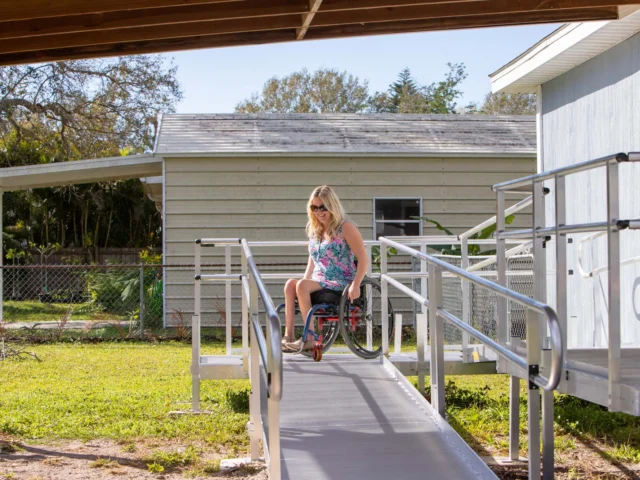
A ramp can make a raised entrance easier to reach, but some homes have limited space for one. The height of the entrance, surrounding walkways, and the person’s mobility needs can also affect whether a ramp is practical.
Alternatives to wheelchair ramps include vertical platform lifts, seated stairlifts, and home elevators. A platform lift allows a person to travel while remaining in a wheelchair or scooter. A seated stairlift requires transferring onto a chair, while a home elevator can provide access between interior floors.
The right choice starts with where you need access and how you will use the equipment.
Which Ramp Alternative Fits My Needs?
Use this comparison to prepare for a professional home assessment.
| Access need | Option to explore | Key consideration |
| Reach a porch, deck, or garage entrance while using a wheelchair | Vertical platform lift | Platform dimensions, combined weight, and landing access |
| Navigate stairs while seated | Stairlift | Ability to transfer onto and off the chair |
| Travel between interior floors | Home elevator | Cabin size, entry clearance, and installation requirements |
| Cross a small doorway height difference | Threshold ramp | Rise, ramp dimensions, and door clearance |
These products solve different access challenges. A dealer can help determine which option fits the user, mobility device, and home.
When Should You Consider an Alternative to a Ramp?
Consider other options when a ramp would take up too much space or would be difficult for the intended user to navigate.
Before choosing equipment, identify:
- The entrance or floors you need to reach
- The vertical height difference
- Available approach and landing space
- Whether the user needs to remain in a mobility device
- Whether the installation will be indoors or outdoors
The goal is a usable route from one area to another, including enough room to approach, enter, exit, and continue through the doorway.
1. Vertical Platform Lifts for Wheelchair and Scooter Access
A vertical platform lift, or VPL, raises and lowers a person on a platform, allowing them to remain in their wheelchair or scooter. It can provide access to a porch, deck, or garage entrance without a long ramp run.
Harmar offers models for different lifting heights:
- VPL400-X: Residential access up to 53 inches, with a 750-pound capacity.
- Highlander II: Multiple height configurations, with the tallest reaching 171 inches and a 750-pound capacity.
The rated capacity must accommodate the rider and mobility device together. Platform dimensions also matter: a weight rating alone does not establish whether a particular wheelchair or scooter fits.
Ask the dealer to assess the approach, platform entry, landing, and doorway as one complete route.
Does a Platform Lift Need Less Space Than a Ramp?
A platform lift can have a smaller footprint than a long modular ramp. However, the platform’s dimensions are only part of the installation space.
You also need room to approach and leave the lift, operate gates, and reach the entrance. Have the dealer compare complete layouts rather than equipment dimensions alone.
2. Stairlifts for People Who Can Transfer to a Seat
A seated stairlift carries a person along an existing staircase. It may be suitable when climbing stairs is difficult but transferring onto and off the chair is manageable.
Indoor and outdoor models are available for different staircase layouts. For exterior access, Harmar offers the Summit outdoor stairlift for straight stairs and an outdoor Helix option for curved stairs.
Choose a model specifically designed for the installation environment. For example, the Summit SL350OD includes marine-grade vinyl seating and protective covers for outdoor use.
Can a Stairlift Replace a Wheelchair Ramp?
A seated stairlift may be an option for someone who can transfer, but it does not transport an occupied wheelchair.
Discuss how the person will move around at both ends of the staircase. If they need to remain in their wheelchair, a platform lift or appropriately sized elevator may better match that requirement.
3. Home Elevators for Access Between Interior Floors
A home elevator can provide an alternative to stairs between interior levels. It is worth considering when the access challenge extends beyond a raised entrance.
Pollock offers shaftless, through-floor residential elevators in multiple cabin sizes, including configurations intended for wheelchair access. These elevators travel through a prepared floor opening rather than a conventional enclosed hoistway.
A professional assessment must confirm structural requirements, usable cabin space, doorway clearance, and room to enter and exit. Not every compact elevator accommodates a wheelchair.
Where Do Threshold Ramps Fit?
A threshold ramp addresses a small height difference near a doorway or floor transition. It remains a ramp, so it belongs in the overall access plan rather than the list of powered alternatives.
Harmar’s aluminum threshold ramps are available in fixed and adjustable configurations. Select the model based on the actual rise, available space, mobility device, and capacity requirements.
How Should I Compare Costs?
Request itemized quotes for solutions that address the same access need.
Ask each provider to identify:
- Equipment and selected options
- Installation and site preparation
- Electrical or structural work
- Any required approvals and inspections
- Maintenance and service costs
- Warranty coverage and exclusions
A useful comparison considers the complete project and ongoing ownership, rather than the equipment price alone.
Will a Lift Work During a Power Outage?
Power-outage operation depends on the model and installed options.
The Highlander II offers an optional ReadyUPS backup system. The Summit SL350OD operates on household AC power, while Pollock lists a battery lowering system for its residential elevator.
Backup lowering and continued travel are different capabilities. Ask the dealer to explain exactly what your chosen equipment can do when power is unavailable.
Questions to Ask During a Home Assessment
Before making a decision, ask:
- Which solution fits this entrance or floor-to-floor route?
- Can I use it while remaining in my mobility device?
- Is there enough space to approach, enter, and exit?
- Does its capacity include my mobility device and any permitted companion?
- What preparation and electrical work are needed?
- What happens during a power outage?
- What training and ongoing service do you provide?
- What is included in the total installed price?
Find a Home Access Solution That Fits Your Routine
Choosing an alternative to a ramp starts with understanding the user’s needs and the home’s layout. A platform lift, stairlift, or residential elevator may offer a practical way to reach the spaces that matter.
Contact a local Harmar dealer to evaluate your home and compare suitable access solutions.