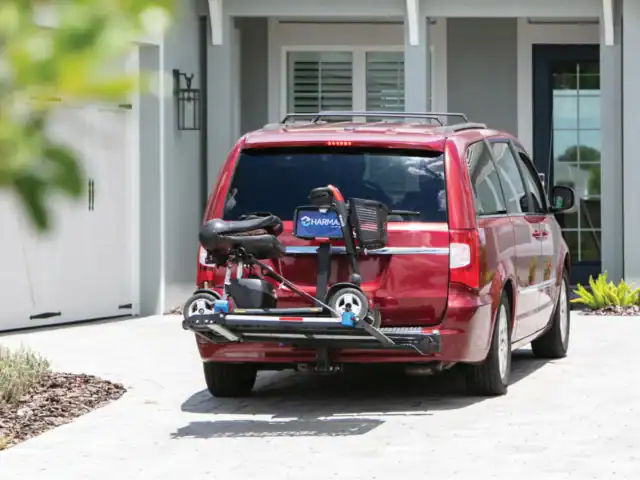
A vehicle lift can make everyday transportation possible without repeatedly disassembling or manually lifting a wheelchair, power chair, or mobility scooter. The right match can help a user reach appointments, visit family, shop, travel, and participate in the community with less physical strain and greater confidence.
An incompatible lift can create the opposite experience. The device may not fit the platform or cargo opening. The combined load may exceed a lift, hitch, or vehicle rating. An inside lift may require more standing, guiding, or reaching than the user can comfortably manage. An outside lift may block a camera, affect vehicle length, or expose the mobility device to weather. Compatibility is therefore more than a product specification—it is the relationship among the complete vehicle, lift, device, and user.
Understanding the Different Types of Vehicle Lifts
Harmar vehicle lifts generally fall into three practical families: hitch-mounted lifts, hoist lifts, and hybrid lifts. Consumers may also describe them as outside or inside vehicle lifts based on where the mobility device is transported.
| Lift type | How it works | Often useful for | Main trade-off |
| Hitch-mounted platform | Attaches at the rear hitch and carries the device outside the vehicle. Powered models raise and lower a platform. | Scooters, power chairs, or manual wheelchairs, depending on the model | Preserves cargo room but adds rear length and weather exposure |
| Hoist lift | Uses a powered lifting arm or crane-like mechanism to raise the device into a trunk, cargo area, or truck bed. | Manual chairs and compatible scooters or power chairs | Protects the device inside, but requires cargo space and hands-on guiding |
| Hybrid lift | A powered platform loads outside, then retracts the mobility device into the cargo area. | Compatible scooters and power chairs | Combines easier platform loading with inside storage, but uses cargo space |
| Manual carrier | Uses a ramp, tilt, or manual loading mechanism rather than powered lifting. | Certain lightweight manual chairs or compact devices | Lower complexity, but requires greater physical effort |
A mobility-device vehicle lift transports the unoccupied wheelchair, power chair, or scooter. It is different from a wheelchair-accessible vehicle ramp or occupied platform system designed to help a person enter while remaining seated in the mobility device.
Start With Your Mobility Device
Before comparing lifts, identify the exact make and model of the device you will transport. “Scooter” or “wheelchair” is not enough because devices vary widely in weight, wheelbase, ground clearance, width, securement points, and how they can be lifted.
Record these details:
- Manufacturer, model, and configuration
- Total transport weight, including batteries, seat, basket, accessories, oxygen holders, and other attached equipment
- Overall length, width, height, wheelbase, and tire or caster position
- Whether components fold, detach, or must remain installed
- Approved lift or securement points
- Any manufacturer restrictions on hoisting or exterior transport
Manual wheelchairs may work with lightweight manual carriers or compact hoists. Many mobility scooters pair well with hitch-mounted platforms, hybrid platforms, or appropriate hoists. Power wheelchairs are often heavier and may have different securement needs, making capacity, platform dimensions, and center of gravity especially important.
Consider Your Vehicle Type
Vehicle category helps narrow the field, but year, make, model, trim, hitch, drivetrain, ride height, and cargo configuration can change what is possible.
- Sedans. Trunk openings and cargo height may favor a compact hoist or a lightweight hitch-mounted solution. Available hitch capacity and rear clearance can be limiting factors.
- Crossovers and SUVs. These vehicles may support hitch-mounted, hoist, or hybrid options. Check cargo opening height, interior dimensions, third-row use, rear visibility, and liftgate clearance.
- Minivans and vans. Large cargo openings can work well with hybrid platforms and hoists, while hitch-mounted lifts preserve seating and interior storage.
- Pickup trucks. A hoist may load the device into the bed, while a hitch-mounted platform carries it behind the truck. Bed covers, tailgates, hitch extensions, and towing plans matter.
For an outside lift, the vehicle must safely support the installed lift plus the fully equipped mobility device at the hitch. For an inside lift, the cargo opening and interior must accommodate not only the parked device but also the lift’s full loading path. A tape-measure check is useful, but it does not replace application-specific verification.
Inside vs. Outside Vehicle Lifts
The storage decision affects nearly every trip. Think about where you park, the weather you encounter, how much cargo room you need, and what the user can physically manage.
| Consideration | Inside vehicle lift | Outside vehicle lift |
| Weather and road debris | Mobility device is protected inside the vehicle | Device is exposed; an approved cover may help when appropriate |
| Cargo and seating space | Uses trunk, cargo, or truck-bed space | Preserves interior cargo and seating areas |
| Loading effort | Hoists may require guiding, rotating, reaching, or folding device components | Powered platforms can offer straightforward drive-on or roll-on loading |
| Vehicle footprint | Does not add a rear platform during travel | Adds length and may affect parking or garage clearance |
| Security and visibility | Device is enclosed; cargo layout and rear visibility still matter | Device is visible outside and may affect sensors, camera view, or license-plate placement |
Weight Capacity and Future Mobility Needs
Never select a lift by comparing its capacity with an estimated or brochure “base weight.” Use the mobility device’s actual transport configuration. Then confirm every relevant rating, including the lift capacity, hitch class and tongue-weight limit, vehicle manufacturer limits, and any adapter or swing-away component rating.
The lift’s installed weight also matters. A simplified planning calculation is: Installed lift + mobility device + adapters/accessories = rear or cargo load to evaluate
Plan beyond today when change is reasonably foreseeable. A user may move from a travel scooter to a larger scooter or power chair, add positioning equipment, or need a caregiver to perform more of the loading. Choosing some appropriate capacity and dimensional margin can reduce the chance that a new mobility device makes the lift unusable—but oversizing without professional review can create unnecessary vehicle load, cost, and bulk.
Ease of Use and Caregiver Considerations
A compatible lift is not automatically a usable lift. Walk through an entire real-world trip: opening the vehicle, preparing the device, loading it, securing it, stowing the lift, unloading at the destination, and reversing the process at home.
Ask whether the primary operator can comfortably:
- Stand and balance for the full loading cycle
- Walk around the rear or side of the vehicle
- Bend, reach, grip, or guide a suspended device
- Fold a scooter tiller, seat, or wheelchair components
- Attach straps, retractors, docking hardware, or a hoist hook correctly
- Use a handheld control while monitoring clearance
- Manage the lift in rain, heat, cold, low light, or a busy parking lot
Features such as powered lifting and folding, automatic hold-down devices, self-tensioning securements, remote or pendant controls, swing-away options, and simple drive-on platforms may reduce effort. The best choice depends on the operator’s strength, balance, dexterity, vision, hearing, cognition, and comfort—not merely the number of automated features.
Installation and Maintenance Requirements
Professional installation helps confirm wiring, hitch or mounting requirements, clearances, securement, platform alignment, and safe operation. Some applications may need a compatible hitch, wiring, battery connection, docking hardware, adapters, or vehicle-specific components. Modifications should be completed only by qualified professionals using manufacturer-approved instructions and parts.
During ownership, keep the platform, securement equipment, electrical connections, moving components, and exposed surfaces clean and inspected according to the manual. Exterior lifts require added attention after road salt, heavy rain, coastal exposure, or debris. Schedule service if the lift becomes noisy, slow, uneven, damaged, corroded, or unreliable. Include installation, accessories, inspections, service, and possible future vehicle or device changes when comparing long-term cost.
Common Mistakes to Avoid When Choosing a Vehicle Lift
- Choosing solely by price. A low purchase price can become expensive if the lift needs adapters, does not fit the next mobility device, or requires more physical effort than expected.
- Using an approximate device weight. Batteries and accessories can materially change the transport weight and dimensions.
- Assuming capacity equals compatibility. A lift may be strong enough but still have the wrong platform size, securement method, geometry, or vehicle application.
- Ignoring the installed lift weight. The vehicle and hitch must account for the lift itself plus the device and approved accessories.
- Overlooking clearance and storage. Consider garage depth, parking spaces, slopes, curbs, cargo openings, liftgate movement, third-row seating, and rear visibility.
- Forgetting the operator. A solution that requires difficult lifting, guiding, or securement may not be sustainable for the user or caregiver.
- Planning only for today. A likely change in mobility equipment or caregiver ability can shorten the useful life of the lift.
- Ordering without final verification. Compatibility tools are guides. Harmar recommends representative or dealer confirmation before an order is placed.
A Simple Vehicle Lift Decision Framework
- Identify the mobility device. Record its exact make, model, actual transport weight, dimensions, accessories, and approved securement or lifting points.
- Evaluate the vehicle. Confirm the exact year, make, model, trim, cargo opening, available interior space, hitch information, vehicle ratings, and relevant clearances.
- Choose a storage preference. Decide whether weather protection and security inside the vehicle outweigh the loss of cargo space—or whether preserving interior room is more important.
- Review capacity and usability. Verify the complete load and make sure the user or caregiver can perform every loading and securement step safely.
- Use the compatibility calculator. Enter the exact vehicle and mobility device to narrow the Harmar lift options.
- Schedule a professional assessment. Have a qualified Harmar dealer confirm the final combination, accessories, installation needs, and day-to-day fit before ordering.
Choose the Lift That Fits Your Life
The best vehicle lift for a wheelchair user or mobility scooter owner is not necessarily the largest, most automated, or most expensive model. It is the lift that safely matches the device and vehicle while making transportation practical for the person who will use it.
Harmar offers hitch-mounted, hoist, and hybrid vehicle lifts for a wide range of mobility devices and vehicles. Start with the Vehicle Compatibility Calculator, then work with a Harmar-certified dealer to translate the technical match into a solution that supports everyday independence—today and as needs change.
Frequently Asked Questions
How do I choose the right vehicle lift for a mobility scooter?
Start with the scooter’s exact make, model, actual weight, dimensions, and wheelbase. Match those details with the vehicle’s year, make, model, cargo or hitch requirements, and the operator’s preferred loading method. Use Harmar’s compatibility calculator and have a dealer verify the final application.
What is the difference between an inside and outside vehicle lift?
An inside lift stores the mobility device in the trunk, cargo area, or truck bed, protecting it from weather but using interior space. An outside lift carries the device on a hitch-mounted platform, preserving cargo room while adding vehicle length and exposing the device to weather and road debris.
Can the same vehicle lift carry both a scooter and a power wheelchair?
Some platform lifts are designed for compatible scooters and power chairs, but not every device will fit or secure correctly. Capacity, platform size, wheel position, securement, and vehicle compatibility must all be verified.
Does a vehicle lift’s weight capacity guarantee that it will fit my device?
No. Capacity is only one requirement. The device must also fit the platform or cargo opening, work with the lift’s securement or hoisting method, and be compatible with the vehicle and installed components.
Can I install a mobility scooter lift myself?
Professional installation is recommended. Vehicle lifts may require hitch verification, electrical connections, vehicle-specific hardware, adjustments, and safety testing. A Harmar-certified dealer can confirm the application and complete the installation correctly.
What happens if I replace my wheelchair, scooter, or vehicle?
Compatibility must be checked again. A new device may have a different weight, wheelbase, or securement requirement, and a new vehicle may have different ratings, cargo dimensions, sensors, or hitch capacity. Do not assume the existing lift can transfer to the new combination.
Find a Compatible Harmar Vehicle Lift
Enter your exact vehicle and mobility-device information to narrow the options, then ask a qualified dealer to confirm the complete application before purchase.
Use Harmar’s Vehicle Compatibility Calculator
Find a Harmar-certified dealer