For many homeowners, the garage is more than a place to park the car—it’s the primary entrance to the home. But garages are also one of the most common places where mobility challenges become apparent. A single step, a steep staircase, or a change in elevation can make everyday access difficult or even unsafe.
Fortunately, today’s home access lifts for garages provide practical solutions for a wide range of mobility needs. Whether you’re looking for a simple stair lift, a wheelchair-accessible platform lift, or a more specialized accessibility solution, choosing the right lift can help you maintain independence and safely access your home for years to come.
This guide explains the most common garage accessibility lifts, how they work, and how to determine which option best fits your home.
Why Garage Access Becomes a Mobility Barrier
Unlike front entrances that may have ramps or level walkways, garages frequently include elevation changes that create accessibility challenges. Many homes require climbing several stairs from the garage into the house, while others have split-level layouts or raised entryways.
These obstacles can become increasingly difficult for:
- Older adults aging in place
- Individuals recovering from surgery or injury
- Wheelchair and scooter users
- People with arthritis, Parkinson’s disease, or other mobility conditions
- Caregivers assisting loved ones
Even a few steps significantly increase the risk of falls. According to the CDC, falls are one of the leading causes of injury among older adults, making safe home access an important part of long-term independence.
Rather than limiting which entrance you use—or relying on assistance every time you come home—garage access solutions can restore confidence while making everyday routines safer and more convenient.
Vertical Platform Lifts for Garage Entry
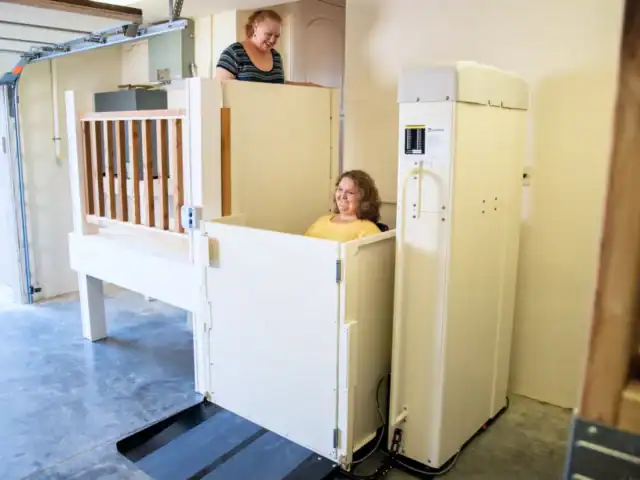
For wheelchair and scooter users, a vertical platform lift for a garage is often the most practical solution.
Sometimes called a wheelchair lift, a vertical platform lift (VPL) raises both the individual and their mobility device vertically between two elevations. Instead of transferring out of a wheelchair, users remain comfortably seated while the platform travels upward.
When a Vertical Platform Lift Is the Best Choice
A VPL is ideal when:
- You use a wheelchair or scooter full-time.
- You cannot safely transfer to a stair lift seat.
- The elevation change is typically between 2 and 14 feet.
- You want to maintain full independence.
Many garage installations are especially well-suited for platform lifts because garages commonly have concrete slab foundations that provide excellent support for installation.
Benefits of Vertical Platform Lifts
- Wheelchair accessible
- No transfer required
- Compact footprint
- Smooth, stable ride
- Suitable for indoor and outdoor applications
- Helps future-proof your home
Vertical platform lifts are an excellent long-term investment for homeowners who anticipate increasing mobility needs over time.
Stairlifts for Garage Steps
If you can safely walk short distances but struggle with stairs, a stairlift for garage steps may be the right solution.
A stairlift consists of a motorized chair that travels along a rail mounted directly to the staircase. Users sit in the chair and ride comfortably between levels before standing at the top.
Best For
Stairlifts work well for individuals who:
- Can safely transfer into a seat
- Walk with a cane or walker
- Experience knee, hip, or balance issues
- Want a cost-effective accessibility upgrade
Because the rail mounts directly to the stairs—not the wall—installation is typically quick and requires minimal structural modifications.
Benefits
- Fast installation
- Minimal home renovation
- Comfortable seated ride
- Foldable seat and footrest help preserve stairway space
- Available for straight and curved staircases
It’s important to remember that stair lifts are not designed for wheelchair users who cannot transfer independently. If remaining in your wheelchair is essential, a platform lift is typically the better option.
Inclined Platform Lifts
An inclined platform lift combines features of both a stair lift and a vertical platform lift.
Instead of carrying a seated passenger, it carries an occupied wheelchair or scooter along the angle of the staircase on a folding platform.
When Are Inclined Platform Lifts Appropriate?
These systems are often used when:
- The user needs to remain in their wheelchair.
- There isn’t enough vertical clearance for a VPL.
- Building layout makes vertical travel impractical.
- The staircase configuration supports rail installation.
Inclined platform lifts are frequently seen in commercial buildings but can also be installed in larger residential garages where space allows.
Advantages
- No wheelchair transfer required
- Uses the existing staircase
- Provides wheelchair accessibility without constructing a ramp
- Platform folds away when not in use
Because they require additional rail space and larger clearances, inclined platform lifts generally work best in wider stairways.
Comparing Garage Lift Types
Choosing between accessibility lifts at home often comes down to mobility level, available space, and long-term goals.
| Feature | Vertical Platform Lift | Stair Lift | Inclined Platform Lift |
| Wheelchair accessible | Yes | No | Yes |
| Transfer required | No | Yes | No |
| Best for stairs | Short elevation changes | Straight or curved stairs | Staircases with wheelchair users |
| Installation footprint | Moderate | Small | Larger |
| Structural modifications | Minimal | Minimal | Moderate |
| Long-term accessibility | Excellent | Good | Excellent |
Cost Considerations
Garage lift pricing varies based on several factors, including:
- Lift type
- Travel height
- Straight versus curved stairs
- Indoor or outdoor installation
- Electrical requirements
- Custom configurations
While stair lifts are generally the most affordable option, vertical platform lifts and inclined platform lifts provide greater accessibility for wheelchair users and often deliver more long-term value.
A professional home evaluation is the best way to receive an accurate estimate.
Key Safety and Installation Considerations
Every garage is different, so installation requirements vary depending on the home’s construction and the lift selected.
Electrical Requirements
Most residential lifts require a dedicated electrical circuit. Your installer will determine whether additional electrical work is needed.
Mounting Surface
Vertical platform lifts typically require a solid, level concrete surface for secure installation.
Stair lifts attach directly to the stair treads rather than the surrounding walls.
Outdoor Exposure
Some garages are fully enclosed, while others have partially exposed entryways.
If your lift may experience moisture, humidity, or temperature fluctuations, selecting equipment designed for outdoor environments is essential.
Local Permits
Many municipalities require permits for residential accessibility equipment, particularly for larger installations.
A qualified dealer can typically assist with permitting requirements and local building code compliance.
Professional Installation
Professional installation helps ensure:
- Safe operation
- Proper alignment
- Code compliance
- Manufacturer warranty protection
- Reliable long-term performance
Working with an experienced installer also helps identify the best lift configuration based on your home’s layout.
How to Choose the Right Lift for Your Garage
Not every garage accessibility challenge requires the same solution.
When evaluating your options, consider these questions:
1. What Is Your Mobility Level?
Can you safely transfer from a wheelchair?
Do you primarily use a cane, walker, scooter, or wheelchair?
Your answer largely determines whether a stair lift or platform lift is appropriate.
2. How Much Elevation Needs to Be Covered?
Measure the vertical distance between the garage floor and the home’s entry door.
Small rises may work well with a vertical platform lift, while longer staircases may require a stair lift or inclined platform lift.
3. How Much Space Is Available?
Some garages have narrow stairways or limited landing areas.
A professional assessment can identify which lift fits safely without interfering with normal garage use.
4. What Are Your Long-Term Plans?
If you’re planning to age in place, consider how your mobility needs may change over time.
Installing a solution that accommodates future wheelchair use may help you avoid additional renovations later.
Making Garage Access Safer and Easier
The right accessibility lift does more than eliminate stairs—it restores confidence, preserves independence, and helps make your home work for you.
Whether you need a simple stair lift for a few garage steps or a fully accessible vertical platform lift for wheelchair use, today’s home accessibility solutions can be customized to fit your space and mobility needs.
A professional home assessment can help determine the safest, most practical option based on your home’s layout, your current mobility, and your future plans.
If you’re exploring home access lifts for your garage, speaking with an experienced accessibility specialist is the best first step toward creating a safer, more accessible home.
Frequently Asked Questions
What is the best lift for garage steps?
The best lift depends on your mobility needs. If you can safely transfer to a seat, a stair lift is often an excellent solution. If you use a wheelchair or scooter and need to remain seated, a vertical platform lift or inclined platform lift is typically the better choice.
Can a wheelchair lift be installed in a garage?
Yes. A garage wheelchair lift can often be installed on a concrete garage floor to provide safe access between the garage and the home’s entry level. Professional installers will evaluate available space, elevation changes, and electrical requirements.
Is a stair lift good for garage entry?
Yes, stair lifts work well for homeowners who can safely sit and stand independently. They provide a convenient way to navigate garage stairs while requiring minimal structural changes.
How much does a garage lift cost?
Pricing depends on several factors, including the type of lift, travel distance, installation complexity, electrical work, and any customizations. A professional consultation is the best way to receive an accurate estimate for your home.
Do garage lifts require permits?
In many areas, yes. Permit requirements vary by municipality and the type of accessibility equipment being installed. Your dealer or installer can help determine local requirements and manage the permitting process if needed.
Are you ready to learn more about home accessibility tools to help you around your forever home? Find a local Harmar dealer on our Dealer Locator to book a free consultation!