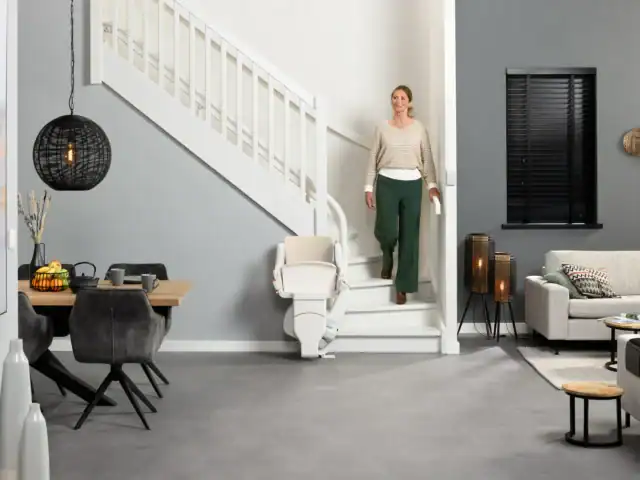
If your home has a staircase that turns, curves, or has landings, you’ve probably already realized something: not all stairlifts are created equal.
So, what exactly is a modular curved stairlift, and how does it compare to other options?
Understanding the difference—especially between modular and fully custom systems—can help you choose a solution that fits your home, your timeline, and your long-term mobility needs.
Understanding Curved Staircases and Why They Are Different
A staircase is considered “curved” if it includes:
- Turns or bends
- Intermediate landings
- Multiple levels or direction changes
- Spiral or sweeping designs
These layouts are common in:
- Two-story homes with split landings
- Entryway staircases with a turn
- Older homes with unique layouts
- Open-concept homes with architectural curves
Why Straight Stairlifts Don’t Work Here
Straight stairlifts are designed for a single, uninterrupted line. Once a staircase changes direction—even slightly—a straight system can’t safely follow that path.
That’s where a stairlift for curved stairs comes in. These systems are built to travel smoothly along complex staircases while maintaining stability and comfort.
What Makes a Stairlift “Modular”
The term “modular” refers to how the stairlift rail is built.
Instead of creating one fully custom, single-piece rail, a modular curved stairlift uses pre-engineered rail sections that are assembled together to match the shape of your staircase.
Think of It Like This:
- Custom rail: One continuous piece, built specifically for your staircase
- Modular rail: Individual pieces, like building blocks, configured to fit your layout
These modular sections are designed to handle common curves, angles, and landings—making them a flexible solution for many homes.
Why This Matters
- Faster production and installation
- Adaptable to many staircase layouts
- Less waiting compared to fully custom fabrication
It’s a practical approach that balances customization with efficiency.
How a Modular Curved Stairlift Works
A curved stairlift system includes several key components working together seamlessly.
Core Components
- Rail System: Follows the exact path of your staircase
- Chassis: The motorized unit that moves along the rail
- Seat: Where the user sits, often with folding arms and footrest
- Power System: Typically battery-powered with charging points along the rail
- Safety Features: Sensors, seatbelts, battery backups, and smooth controls
How It Moves
The lift travels along the rail, navigating turns and landings with controlled, steady motion. The system is designed to:
- Maintain balance around curves
- Start and stop smoothly
- Provide a stable ride throughout
Space-Saving Design
When not in use:
- Seats fold up
- Footrests tuck away
- Rails are positioned to minimize obstruction
This makes it easier for others to continue using the stairs normally.
Modular vs. Custom Curved Stairlifts
One of the biggest questions homeowners have is: Should I choose modular or fully custom.
Here’s a clear comparison:
Design Approach
- Modular Curved Stairlift: Uses pre-engineered rail sections configured to your staircase
- Custom Curved Stairlift: Built as a single, continuous rail specifically for your layout
Installation Timeline
- Modular: Typically faster due to pre-made components
- Custom: Longer lead times due to fabrication
Flexibility
- Modular: Works well for standard curved layouts with predictable turns
- Custom: Better for highly complex or unique staircases
Cost Considerations
- Modular: Often more cost-efficient due to standardized components
- Custom: Can be higher due to bespoke design and manufacturing
Best For
- Modular: Most curved staircases with standard turns and landings
- Custom: Spiral staircases or highly intricate designs
The right choice depends on your staircase—not just preference.
When a Modular Curved Stairlift Is the Right Choice
A modular curved stairlift is often the ideal solution when:
- Your staircase includes standard turns or landings
- The layout is predictable and not highly complex
- You’re looking for a faster installation timeline
- You want a balance between customization and efficiency
For many homeowners, modular systems provide everything needed—without the longer wait associated with fully custom fabrication.
Situations Where a Fully Custom Curved Stairlift May Be Better
There are cases where a fully custom solution makes more sense.
Consider Custom If:
- The staircase is spiral or unusually shaped
- There are tight or irregular angles
- The layout includes complex architectural features
In these situations, a custom-built rail ensures the system fits perfectly and operates smoothly.
A professional assessment will help determine which option is best.
Installation Process for Modular Curved Stairlifts
One of the advantages of modular systems is a more streamlined installation process.
What to Expect
Home Assessment
A professional evaluates your staircase, layout, and mobility needs
Precise Measurements
Detailed measurements ensure the rail fits correctly
Configuration Planning
Modular rail sections are selected and arranged for your staircase
Installation
The system is installed directly onto the stair treads—not the wall
Testing and Walkthrough
The installer tests the system and shows you how to use it safely
Minimal Disruption
- No major renovations required
- Installation is typically completed efficiently
- Your home structure remains largely unchanged
Safety and Comfort Features
Modern curved stairlift systems are designed with both safety and usability in mind.
Standard Safety Features
- Seatbelts
- Obstruction sensors (stop the lift if something is in the way)
- Smooth start-and-stop operation
- Swivel seats for safer entry and exit
Comfort Features
- Padded seating
- Easy-to-use controls
- Optional remote controls
- Folding components for space efficiency
Reliability
These systems are built for daily use, with ongoing maintenance and support available to ensure long-term performance.
How to Determine If Your Home Is a Good Candidate
If you’re considering a curved staircase stairlift, a quick self-check can help you get started.
Ask Yourself:
- Does my staircase have turns, landings, or curves?
- Is using the stairs becoming more difficult or tiring?
- Would reducing strain improve daily comfort?
- Do I want to stay in my home long-term?
What a Professional Will Evaluate
- Staircase width and layout
- Landing size and spacing
- Structural considerations
- User mobility needs
A professional assessment ensures the solution fits both the home and the person using it.
Final Thoughts
A modular curved stairlift offers a practical, adaptable solution for many curved staircases—combining thoughtful design with faster installation and everyday reliability.
While fully custom systems still have their place, modular options have made curved stairlift installation more accessible than ever for homeowners navigating turns, landings, and multi-level living.
And ultimately, that’s what matters most: finding a solution that helps you move safely, comfortably, and confidently—right at home. If you’re ready for the next step (pun intended), reach out to your local Harmar-certified dealer for a free consultation!