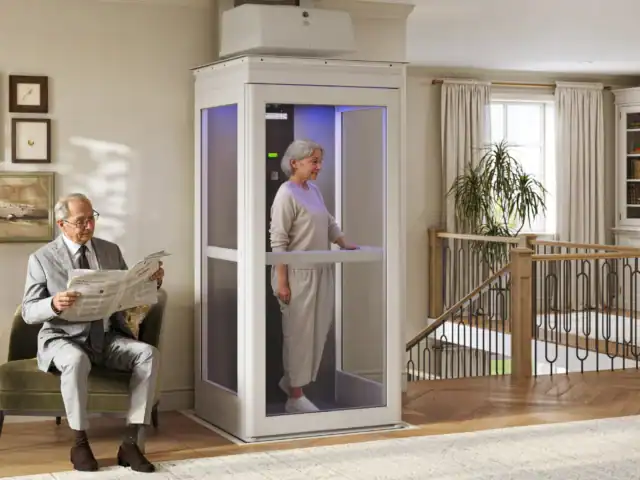
When stairs become difficult, one of the biggest questions older adults and their families face is: “Do I stay, or do I go?”
You may have lived in your home since your children were toddlers. It holds decades of memories, familiar routines, and the belongings that make it feel like yours. Moving may never have been part of the plan—but now, the stairs between you and your bedroom, bathroom, laundry room, or other essential spaces are becoming harder to manage.
That does not necessarily mean you have to leave.
Alison Starkey, PT, MBA, MHA, CAPS, CFPS, is a physical therapist and founder/owner of North Carolina-based Gaitway of Charlotte, LLC. She regularly sees how the right accessibility solution can help someone remain safer, more independent, and more comfortable in the place they love.
A home elevator is a significant investment, and it will not be the right solution for every person or every property. But for someone who wants to age in place and continue accessing multiple levels of their home, it may provide long-term benefits that other mobility solutions cannot.
Here are six recommended questions to consider when deciding whether a home elevator fits your aging-in-place plans.
1. Do You Want to Remain in Your Current Home?
The first question is also the most personal: Is your goal to remain in your current home for as long as possible?
Aging in place is about more than staying at the same address. It means determining whether your home, support system, finances, and community can continue meeting your needs.
Before investing in a major home modification, consider:
- Do you have family members, friends, neighbors, or paid caregivers who could assist you if needed?
- Can you manage routine maintenance, such as replacing filters and light bulbs or arranging plumbing and household repairs?
- Do you have regular opportunities to connect with friends, family, and your community?
- Can you prepare nutritious meals or access meal preparation and delivery services?
- Do you have reliable transportation for appointments, errands, and social activities?
- Can the home be modified to accommodate changing mobility needs?
Organizations such as the National Council on Aging recommend considering personal care, household maintenance, transportation, nutrition, social connection, finances, and home safety as part of a complete aging-in-place plan.
If your home and support network can continue serving you well—and the primary obstacle is safely traveling between floors—you may be a strong candidate for a home elevator.
2. Do You Need a Short-Term or Long-Term Solution?
A home elevator is a substantial home modification. Before making that investment, it is important to consider how long you expect to use it and whether it can accommodate both your current and potential future needs.
A temporary mobility limitation following an injury or surgery may call for a different solution than a progressive condition or a long-term commitment to aging in place. Your physical therapist, occupational therapist, physician, accessibility professional, and family can help you evaluate what may be appropriate.
The financial comparison should extend beyond the initial price of the elevator. Depending on your situation, you may also want to compare:
- The installed cost of different home-access solutions
- Structural modifications and permit requirements
- Ongoing inspection, service, and maintenance costs
- In-home caregiving expenses
- The cost of moving and modifying another home
- Independent living or assisted living expenses in your area
- How long each option is expected to meet your needs
There is no universal timeframe in which an elevator “pays for itself.” Installation costs, senior-living fees, caregiving needs, and home requirements vary considerably. The better question is whether the elevator provides sufficient long-term value for your needs, finances, and desired lifestyle.
3. Are Your Main Bedroom and Bathroom Upstairs?
For many older adults, the most important rooms in the house are not on the main floor.
A downstairs living space may be comfortable during the day, but it does not necessarily solve the problem if the primary bedroom, full bathroom, or laundry area remains upstairs. Converting a first-floor room may be possible, but renovations can be disruptive and may still require compromises.
A properly selected home elevator can preserve access to more of the house instead of limiting daily life to one floor. Depending on the model, configuration, and capacity, it may also accommodate certain wheelchairs or other mobility devices.
That future flexibility matters. Someone who walks independently today may later use a cane, walker, rollator, or wheelchair. Planning for potential changes can help a modification remain useful for longer.
Product dimensions and weight capacities vary, so confirm that the elevator can accommodate the user, mobility device, caregiver assistance, and anticipated future needs before purchasing.
4. Can You Use the Alternatives Safely and Independently?
Stairlifts are an excellent accessibility solution for many people. They are generally less extensive to install than a home elevator and may be appropriate when someone can safely transfer onto and off the stairlift seat.
However, the best solution depends on the individual’s strength, balance, mobility, cognition, and ability to operate the equipment.
When evaluating a stairlift, consider whether the user can:
- Approach and transfer onto the seat safely
- Maintain a stable seated position during travel
- Use the seat belt, armrests, and footrest as directed
- Operate the controls
- Transfer safely at both the top and bottom of the stairs
- Access another mobility device on the destination floor, if needed
A physical or occupational therapist can assess functional abilities, while a qualified accessibility professional can evaluate the staircase and recommend suitable equipment. If transfers are unsafe or the person primarily uses a wheelchair, a conventional seated stairlift may not be the most appropriate long-term option.
Ramps may also be useful for smaller elevation changes, entrances, and some garages. Reaching an entire upper floor with a ramp, however, usually requires considerable space because safe ramp configurations may need substantial length, landings, and turns.
Whatever solution you choose, it should be considered alongside a household emergency plan. Do not assume a home elevator or lift can be used during a fire, power failure, or other emergency. Follow the manufacturer’s instructions and guidance from local fire and building officials.
5. How Could an Elevator Affect the Home’s Value?
A home elevator may make a multistory property more attractive to certain buyers, including older adults, people with mobility limitations, and families seeking a multigenerational home.
Research from the National Association of Home Builders indicates that many buyers value accessibility features such as step-free entrances, wider doorways, wider hallways, nonslip flooring, and a full bathroom on the main level.
An elevator can become part of that broader accessibility story. It may also make moving groceries, luggage, laundry, and other items between floors more convenient for a wide range of users.
However, no home modification can guarantee a specific increase in resale value. The effect will depend on factors such as:
- The local housing market
- Buyer preferences
- Installation quality
- Elevator condition and appearance
- Available service and maintenance records
- How well the elevator fits the home’s layout
- Whether the modification preserved other usable space
Before treating potential resale value as part of the financial equation, consult a local real estate professional who understands accessible and multigenerational homes.
6. What Is the Value-to-Cost Equation for You?
The true value of a home elevator cannot be measured by installation cost alone.
For some homeowners, the value comes from maintaining access to an upstairs bedroom and bathroom. For others, it is the ability to move between floors without transferring out of a wheelchair or relying on another person.
An elevator may also make everyday household tasks easier. Groceries, laundry, luggage, and other belongings can be moved between floors without being carried up the stairs.
The value equation may include:
- Continued use of the entire home
- Greater independence in daily routines
- Reduced stair-related fall exposure
- Less physical strain when moving household items
- Accommodation of certain mobility devices
- Greater flexibility as mobility needs change
- The emotional value of remaining in a familiar home
Is a Home Elevator Right for You?
A home elevator is not simply a way to avoid the stairs. It can be part of a broader plan to preserve independence, maintain access to important living spaces, and make a multistory home work better over the long term.
As Alison explains:
“Home elevators can be a wonderful long-term solution for clients who are not good candidates for a stairlift and wish to age in place.”
The decision should be made with careful consideration of your mobility, home layout, support system, finances, and future needs. Begin by speaking with a healthcare professional who understands your functional abilities. Then, schedule an in-home evaluation with a qualified elevator professional who can review available space, product options, installation requirements, applicable codes, and long-term maintenance.
The question may begin with, “Do I stay, or do I go?” With the right planning and home-access solution, staying may remain a safe and realistic possibility.
Contributed by Alison Starkey, PT, MBA, MHA, CAPS, CFPS
Alison Starkey is a physical therapist and the founder/owner of Gaitway of Charlotte. Her perspective combines clinical knowledge, aging-in-place planning, fall-prevention awareness, and an understanding of the practical considerations that help people remain independent at home.