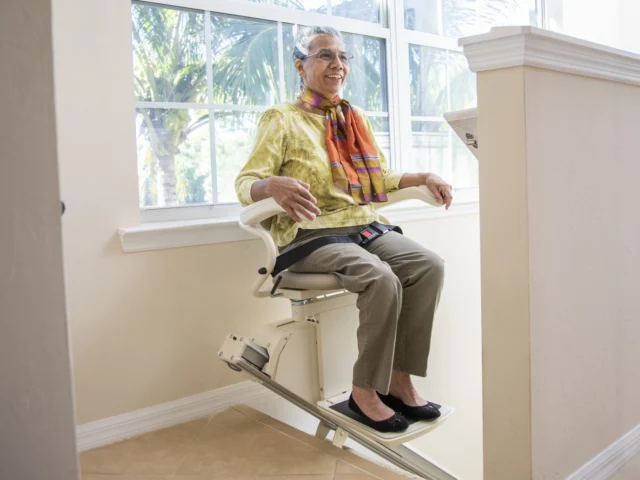
A stairlift is a motorized chair that travels along a rail installed beside a staircase, allowing a person to move between floors while seated rather than walking up or down the stairs.
Stairlifts are designed primarily for people whose permanent or chronic physical impairments substantially limit their ability to walk or safely navigate stairs. They may also be useful in other circumstances when someone has difficulty using stairs.
A typical stairlift includes a seat, rail, motorized carriage, footrest, controls, and safety features. Straight and curved stairlifts are available for different staircase configurations, and certain models are designed for outdoor use.
Unlike a wheelchair platform lift or residential elevator, a conventional stairlift transports a seated person—not their wheelchair.
How Does a Stairlift Work?
A stairlift uses a motorized carriage to move a seat along a rail installed beside the staircase.
The rail follows the path of the stairs, while the chair carries the user between the upper and lower landings.
Most stairlifts are operated using a control on the armrest.
How to Use a Stairlift
A typical stairlift journey involves five steps:
- Sit on the stairlift. The user transfers onto the seat at the landing.
- Secure the seat belt. The user fastens the belt and positions their feet on the footrest.
- Operate the control. The user activates the travel control to move the chair along the rail.
- Arrive at the landing. The stairlift stops at its designated position.
- Exit the chair. The user swivels the seat when applicable and transfers off the stairlift safely.
Operation varies by model. Users should follow the manufacturer’s instructions and receive training from their installer.
What Are the Main Parts of a Stairlift?
Although features vary, most residential stairlifts share several components.
| Component | What It Does |
| Rail | Guides the stairlift along the staircase |
| Motorized carriage | Moves the chair along the rail |
| Seat | Supports the user during travel |
| Seat belt | Helps keep the user secured while seated |
| Armrests | Provide support and typically house the operating control |
| Footrest | Supports the user’s feet during travel |
| Swivel seat | Helps position the user for entry and exit |
| Call/send controls | Allow the empty stairlift to be moved between landings on compatible models |
| Obstruction sensors | Help stop movement when certain obstructions are detected |
| Power system | Supplies electricity for stairlift operation |
The exact components and available features depend on the model.
What Are the Different Types of Stairlifts?
Stairlifts are generally categorized by the staircase they are designed to accommodate.
Straight Stairlifts
A straight stairlift travels along a rail installed on a staircase without turns or intermediate landings that change the direction of travel.
Straight stairlifts are common in homes with a single, continuous staircase.
They generally require less rail customization than curved stairlifts.
Curved Stairlifts
A curved stairlift follows a rail configured for a staircase with turns, curves, intermediate landings, or changes in direction.
Depending on the model, curved stairlifts may use custom-fabricated or modular rail systems.
Outdoor Stairlifts
Outdoor stairlifts are designed for compatible exterior staircases.
They incorporate materials and protective features suited to outdoor environmental conditions.
An indoor stairlift should not be used outdoors unless the manufacturer specifically approves that application.
Heavy-Duty Stairlifts
Heavy-duty stairlifts are designed to accommodate higher user weight capacities and may offer additional seating space.
Harmar offers select stairlift models with weight capacities of up to 600 pounds.
The appropriate model depends on the user’s weight, body dimensions, transfer needs, and staircase configuration.
Straight vs. Curved Stairlifts: What’s the Difference?
| Feature | Straight Stairlift | Curved Stairlift |
| Staircase | Continuous straight run | Turns, curves, or changes in direction |
| Rail | Straight | Custom-configured or modular |
| Customization | Generally less | Generally more |
| Installation planning | Usually simpler | May require additional measurement or rail preparation |
| Cost | Generally lower | Generally higher |
| Best suited for | Straight staircases | More complex staircase layouts |
The staircase determines which rail configuration is appropriate. A qualified dealer can assess the home and recommend compatible equipment.
Who Is a Stairlift Designed For?
Stairlifts are primarily intended to provide seated access between floors for people with permanent or chronic mobility impairments.
They may be appropriate for someone experiencing:
- Difficulty walking up or down stairs
- Reduced leg strength or endurance
- Balance limitations
- Joint pain or restricted movement
- Certain mobility limitations associated with neurological or chronic conditions
- Difficulty safely accessing different floors of the home
A diagnosis or age alone does not determine whether someone should use a stairlift.
The person’s functional abilities are equally important.
Can Someone Who Uses a Wheelchair Use a Stairlift?
Some wheelchair users can use a stairlift if they can safely transfer between their wheelchair and the stairlift seat.
However, the wheelchair does not travel with the user on a conventional stairlift.
If the person cannot transfer safely or needs to remain in their wheelchair, a vertical platform lift or residential elevator may be more appropriate.
What Are the Benefits of a Stairlift?
A stairlift may offer several practical benefits when it is appropriate for the user and home.
Seated Access Between Floors
A stairlift allows the user to travel between levels without walking up or down the staircase.
Less Physical Effort on Stairs
For someone with reduced strength, balance, or endurance, seated travel may reduce the physical demands associated with climbing stairs.
Limited Structural Changes
Many residential stairlifts are installed using brackets secured to selected stair treads.
Major remodeling is often unnecessary, although site-specific work may still be required.
Access to More Areas of the Home
A stairlift may allow someone to continue accessing bedrooms, bathrooms, and living spaces located on different floors.
Options for Different Staircases
Straight, curved, outdoor, and heavy-duty configurations allow stairlifts to accommodate a range of home layouts and user needs.
What Are the Limitations of a Stairlift?
Stairlifts are not appropriate for every situation.
Important limitations include:
- Transfers: The user must be able to transfer safely onto and off the chair, independently or with appropriate assistance.
- Wheelchair transportation: A conventional stairlift does not carry a wheelchair.
- Staircase space: The rail and chair occupy part of the staircase.
- Weight capacity: Each model has specific weight and seating limits.
- Landing clearance: Adequate space is required for safe entry and exit.
- Multiple floors: Access to additional levels depends on the staircase and rail configuration.
- Maintenance: Stairlifts require appropriate care and periodic inspection.
A stairlift should not be used to transport items or passengers beyond the manufacturer’s approved use.
What Safety Features Do Stairlifts Have?
Modern stairlifts may include several safety features designed to support appropriate operation.
Depending on the model, these may include:
- Seat belts
- Obstruction sensors
- Swivel-seat interlocks
- Overspeed protection
- Key locks
- Audible alerts
- Call/send controls
- Battery-powered operation during a household power outage
Not every feature is available on every stairlift.
Safety features do not eliminate all risks, and the equipment must be installed, operated, and maintained according to the manufacturer’s instructions.
How Are Stairlifts Installed?
Most residential stairlifts are installed along the staircase using rail brackets secured to selected stair treads.
A typical professional installation includes:
- Measuring and assessing the staircase.
- Confirming the rail configuration and equipment requirements.
- Positioning and securing the rail brackets.
- Installing the rail, carriage, and chair.
- Connecting the appropriate power or charging system.
- Testing the equipment and safety features.
- Demonstrating operation and training the user.
Straight stairlift installation can often be completed within a few hours once the equipment is available and the site is ready.
Curved stairlifts may require additional preparation because their rails must accommodate turns or changes in direction.
Do Stairlifts Work During Power Outages?
Many stairlifts use rechargeable batteries and can continue operating for a limited number of trips during a household power outage.
The available travel depends on battery condition, stairlift model, rail length, user weight, and other factors.
However, not all stairlifts are battery-powered.
Some models operate directly from household AC power and will not operate normally without electricity.
Ask your dealer about the power system and outage procedures for the selected stairlift.
How Much Does a Stairlift Cost?
The cost of a stairlift depends on the model, staircase, rail configuration, options, and installation requirements.
As general planning estimates:
| Stairlift Type | Approximate Starting Price |
| Straight stairlift | $4,000–$5,000 for many new installations |
| Curved stairlift | Often starts around $9,000 |
| Outdoor stairlift | Varies by model and staircase |
| Heavy-duty stairlift | Varies by model and installation |
These are general estimates, not guaranteed prices. Actual costs vary by dealer, location, staircase, and selected equipment.
A professional assessment and itemized quote provide a more accurate estimate.
Stairlift vs. Home Elevator: What’s the Difference?
Both stairlifts and residential elevators provide access between floors, but they serve different needs.
| Feature | Stairlift | Residential Elevator |
| How it transports the user | Seated chair along a staircase | Enclosed or partially enclosed lift between floors |
| Wheelchair transportation | No, not with a conventional stairlift | May accommodate compatible wheelchairs, depending on model |
| Installation | Typically attaches to the staircase | Often requires additional construction and space |
| Cost | Generally lower | Generally higher |
| Space requirements | Uses part of the existing staircase | Requires a designated elevator location |
| Best suited for | Someone who can sit and transfer safely | Users needing a different method of access between floors |
For someone who needs to remain in a wheelchair while traveling between floors, a residential elevator or suitable platform lift may be more appropriate.
How Do I Know Which Stairlift Is Right for My Home?
The appropriate stairlift depends on both the staircase and the user.
Before choosing a model, consider:
- Is the staircase straight or curved?
- Will the stairlift be installed indoors or outdoors?
- What is the user’s weight?
- Can the user sit securely?
- Can the user transfer safely at both landings?
- Can the user operate the controls?
- Is there sufficient staircase and landing clearance?
- Are powered or folding features needed?
- What maintenance and service support is available?
A qualified stairlift dealer can assess the staircase and recommend compatible equipment.
For complex mobility needs, an occupational therapist or other qualified healthcare professional can help evaluate whether seated stairlift use is appropriate.
Frequently Asked Questions About Stairlifts
What is the purpose of a stairlift?
A stairlift provides seated transportation along a staircase for someone who has difficulty safely walking up or down stairs.
How does a stairlift move?
A motorized carriage travels along a rail installed beside the staircase, carrying the seated user between landings.
Is a stairlift the same as a chairlift?
The terms stairlift, stair chair lift, and stairway chairlift are sometimes used interchangeably when describing a motorized chair that travels along stairs. However, chairlift can also refer to other types of equipment.
Do stairlifts attach to the wall?
Most residential stairlifts are supported by brackets secured to the staircase rather than directly to the wall.
Can a stairlift be installed on curved stairs?
Yes. Curved stairlifts use rail systems configured for staircases with turns, curves, or intermediate landings.
Can two people ride a stairlift together?
Conventional residential stairlifts are designed to transport one seated rider at a time.
Do stairlifts require electricity?
Yes. Stairlifts require electrical power, either directly from household electricity or through a rechargeable battery system.
Can a stairlift be removed?
Yes. Stairlifts can generally be removed by a qualified technician. Mounting holes or other minor changes to the staircase may need repair afterward.
Is a stairlift suitable for someone who cannot walk?
Potentially, if the person can safely transfer onto and off the seat and meet the other operating requirements. If they need to remain in a wheelchair, another accessibility solution may be more appropriate.
Are stairlifts only for older adults?
No. Stairlift suitability depends on mobility limitations and functional needs, not age alone.
Learn More About Harmar Stairlifts
A stairlift is a seated home accessibility solution that allows a person to travel along a staircase without walking up or down the steps.
Straight, curved, outdoor, and heavy-duty models are available to accommodate different staircases and user requirements.
If you’re considering a stairlift, a qualified Harmar dealer can evaluate your staircase, explain the available options, and help identify a model suited to your needs.
For more information about stairlift types, features, costs, and installation, explore Harmar’s complete Stairlift Buyer’s Guide.