

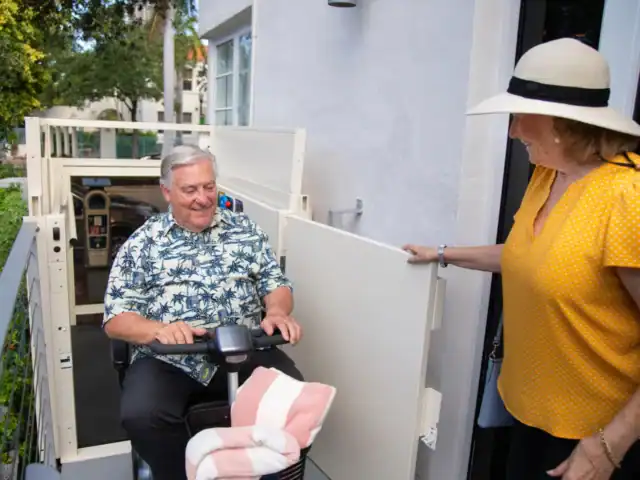
Platform lifts can be a valuable aging-in-place investment for people who use wheelchairs, scooters, power chairs, walkers, or other mobility aids. Unlike a stairlift, a platform lift may allow the user to remain with a compatible device. Unlike a ramp, a vertical platform lift can overcome a raised entrance without a long sloped pathway.
The best solution depends on the user, device, home, space, and future needs. For many households, a platform lift can preserve essential access while reducing difficult transfers and caregiver assistance.
What Is Aging in Place?
Aging in place means continuing to live safely, comfortably, and independently in a familiar home as a person grows older. It does not mean living without help or refusing change. It means adapting the home, routines, services, and support system so the environment continues to fit the person.
Many homeowners prefer accessibility improvements because home is connected to routines, community, memories, and control. Moving can introduce expense and disruption without guaranteeing better long-term access.
Aging-in-place accessibility planning may include:
- Creating at least one step-free entrance.
- Improving access to bedrooms, bathrooms, kitchens, garages, and outdoor areas.
- Widening or clearing travel paths for mobility devices.
- Adding grab bars, improved lighting, and slip-resistant surfaces.
- Using stairlifts, ramps, platform lifts, or home elevators where levels change.
- Planning for caregivers, emergency access, and future equipment.
Accessible modifications work best before a daily route becomes unsafe. A platform lift can be part of that strategy instead of a last-minute response to a mobility change.
What Is a Platform Lift?
A platform lift carries a person between levels on a powered platform. Depending on the application and mobility device, the user may roll or walk onto it, operate the controls, travel, and exit without transferring to a separate seat.
Platform lifts commonly serve wheelchair and scooter users but may also support power chairs, walkers, or other aids. Compatibility depends on the model, platform dimensions, capacity, configuration, and device.
Vertical Platform Lifts
A vertical platform lift, or VPL, moves up and down between landings. It is often used to provide access to a porch, deck, garage entrance, raised doorway, or another short change in elevation. Available configurations may serve indoor or outdoor applications and different travel heights.
A VPL is sometimes called a wheelchair platform lift or porch lift. Unlike a home elevator, it may not require a full hoistway, although site construction, gates, enclosures, or other components may be required depending on the installation and local rules.
Inclined Platform Lifts
An inclined platform lift travels along a staircase. Instead of transferring into a stairlift seat, a user travels on a platform with a compatible wheelchair. The platform may fold when not in use to preserve part of the stairway width.
An inclined lift requires adequate staircase width, landing clearance, and structural support. Turns and intermediate landings also affect feasibility. Mobility-device compatibility varies, so the dealer must confirm whether the user and device fit the proposed application.
For more detail, read Vertical vs. Inclined Platform Lifts: What’s the Difference?.
Why Platform Lifts Support Long-Term Independence
Long-term independence is not simply the ability to remain home. It is the ability to reach the spaces needed for ordinary life without avoidable risk or constant assistance.
When steps block an entrance, garage, porch, or level, the user may avoid spaces, wait for help to leave, or rely on someone to move a mobility device. A platform lift can restore a consistent route.
Key platform lift benefits may include:
- Access with a mobility device: A compatible wheelchair, power chair, or scooter can remain with the user on many vertical platform lifts.
- Fewer transfers: Reducing transfers may help users who have limited strength, balance, coordination, or endurance.
- More independent entry and exit: Properly selected equipment may allow a user to navigate a raised entrance without another person lifting the user or mobility device.
- Support for changing mobility: A lift chosen around current and anticipated device dimensions and weight may remain useful as needs evolve.
- Reliable daily routines: Easier access can support appointments, errands, social activities, outdoor time, and movement between the home and garage.
Together, these benefits can make a platform lift part of the home’s long-term accessibility infrastructure.
Platform Lifts vs. Stairlifts
Stairlifts and platform lifts both help people avoid climbing steps, but they serve different users and spaces.
A stairlift carries a person in a seat mounted to a rail along the staircase. It is often a compact, practical choice for someone who can approach the chair, transfer safely, remain seated, and transfer off at the destination. It does not carry an occupied wheelchair or mobility scooter.
A platform lift is designed around platform access. It may be the better aging-in-place option when the user:
- Needs to remain with a compatible wheelchair or mobility device.
- Cannot transfer safely or consistently into a stairlift seat.
- Would otherwise need a second mobility device at the opposite landing.
- Is likely to need wheeled mobility support in the future.
- Needs access at a raised entrance rather than along a staircase.
Platform lifts generally require more space and planning. A stairlift may be simpler when transfers remain safe and the staircase is the only barrier. Choose according to transfer ability, mobility-device use, layout, and future needs.
Harmar’s guide to stairlifts, platform lifts, and home elevators offers additional decision points.
Platform Lifts vs. Ramps
Both ramps and platform lifts can create wheelchair-accessible routes, but they use space differently.
A ramp provides a sloped pathway and does not require powered operation. It may be practical for a low rise, generous outdoor area, or temporary need. However, the higher the entrance, the longer the ramp generally needs to be to maintain an appropriate slope. Turns, landings, property boundaries, landscaping, and driveway or sidewalk access can make that footprint difficult to accommodate.
A vertical platform lift travels upward within a comparatively compact footprint. It can be useful where an entrance is high, yard or garage space is limited, or a long ramp would be inconvenient. Powered travel may also reduce the effort needed to propel a manual wheelchair up an incline.
Weather affects both solutions. Keep outdoor ramps and platforms clear of water, leaves, snow, ice, and debris. Outdoor lifts need equipment intended for the environment and manufacturer-recommended maintenance.
When comparing a platform lift vs. ramp, consider:
- Vertical rise and available horizontal space.
- The user’s ability to navigate an incline.
- Manual wheelchair, power chair, scooter, or walker use.
- Drainage, weather exposure, and surface maintenance.
- Electrical availability and backup-power options.
- Local codes, permits, and inspection requirements.
- Long-term convenience for the user and caregiver.
For more guidance, check out our blog: When a Ramp Isn’t the Right Accessibility Solution.
How Platform Lifts Can Improve Home Safety
Steps and transfers can become more difficult as balance, strength, coordination, vision, joint mobility, or endurance changes. Carrying a person or mobility device on stairs can also create risk for both the user and helper.
A properly selected and professionally installed platform lift can improve safety by:
- Providing controlled movement between two landings.
- Allowing many users to remain with a compatible mobility device.
- Reducing repeated standing, pivoting, and sitting transfers.
- Removing the need to climb entrance steps while carrying items.
- Creating a consistent route into or out of the home.
- Using gates, interlocks, obstruction protection, emergency controls, and other safety features as equipped.
The lift does not make the surrounding area automatically accessible. Users still need clear approach paths, adequate turning room, stable landings, suitable door clearance, and safe entry and exit. The mobility device must fit within the usable platform and remain within the lift’s rated capacity.
How Platform Lifts Support Caregivers
Caregiving may involve steadying someone on steps, assisting transfers, moving a wheelchair, or coordinating entry. Repeated lifting and awkward positioning can strain the caregiver and increase dependence.
A platform lift may reduce that burden by allowing the user and mobility device to travel together. It can eliminate the need to carry a wheelchair up steps, reduce the number of transfers in a daily routine, and make departures or arrivals easier to manage.
Caregiver support remains important, especially when the user needs help operating controls, positioning a device, opening a door, or navigating the landing. The goal is not to remove the caregiver from the picture. It is to reserve assistance for tasks that truly require another person instead of using physical effort to compensate for an inaccessible home.
Key Platform Lift Features to Look For
Features and terminology vary by model. An authorized dealer should confirm which options are included, available, or required for the proposed installation.
Weight Capacity and Platform Size
Calculate the combined weight of the user, mobility device, and any regularly carried items. Confirm that the usable platform dimensions accommodate the device with enough room for safe positioning and entry or exit. Do not exceed the manufacturer’s rated capacity.
Gates, Doors, and Interlocks
Landing gates or doors help protect open edges. Interlocks may prevent lift movement unless the appropriate gate or door is secured. The required configuration depends on travel height, entry and exit direction, site design, and applicable requirements.
Obstruction Protection and Emergency Controls
Depending on the model, features may include an emergency stop, platform safety pan, obstruction sensors, overspeed protection, non-slip surfaces, and constant-pressure controls. Ask the dealer to explain each feature and demonstrate normal and emergency operation.
Power and Battery Backup
Platform lifts require a compatible power source. Some systems may include or offer battery operation or backup power, but performance and purpose vary. Ask what happens during an outage, how the batteries are maintained, and whether the lift can complete a trip or lower to a safe landing.
Outdoor Protection
For an outdoor installation, select equipment approved for outdoor use. Discuss environmental exposure, drainage, temperature, corrosion protection, covers or enclosures, and maintenance. Weather protection does not eliminate the need to keep landings and the platform clear.
User Controls
Controls should be reachable and manageable for the intended user. Consider hand strength, dexterity, reach, vision, and cognitive needs. Call stations at the landings may also be useful for caregivers or other household members, depending on the model.
Platform Lift Installation Considerations
A professional assessment should evaluate the person, mobility device, route, home, and installation requirements together.
Important planning factors include:
- Location: Which entrance or level change creates the greatest barrier?
- Space: Is there enough room for the lift, approach, turning, gates, doors, and clear landings?
- Travel height: How far must the platform move, and what guarding or enclosure may be required?
- Entry and exit: Will the user enter and exit on the same side, opposite sides, or at an angle?
- Site preparation: Does the project require a concrete pad, structural work, drainage, a new doorway, or landing changes?
- Electrical service: What circuit, disconnect, charging, or backup-power provisions are needed?
- Permits and inspections: Which building, electrical, elevator, zoning, or other local requirements apply?
- Service access: Who will maintain and repair the equipment after installation?
Requirements vary by jurisdiction and project. A qualified dealer can recommend a compatible configuration and help clarify which contractors, permits, and inspections may be involved. Review Harmar’s home access products for wheelchair users for a more detailed evaluation checklist.
Planning for Future Mobility Needs
An aging-in-place plan should solve today’s barrier without ignoring tomorrow’s likely needs. That does not require predicting every medical change. It means choosing dimensions, capacity, location, and controls with reasonable flexibility.
Before selecting a platform lift, ask:
- Could the user move from a walker or manual wheelchair to a larger power chair or scooter?
- Would a caregiver need to travel with or closely assist the user?
- Are the planned platform dimensions and weight capacity sufficient for likely equipment?
- Will the lift serve the entrance used for medical appointments, errands, and emergency access?
- Could a door swing, parked vehicle, trash bin, or outdoor furniture block the approach?
- Can the user operate the controls if strength, dexterity, reach, or vision changes?
- Is the chosen location protected enough for reliable year-round access?
- Does the service plan support long-term ownership?
Also look beyond the lift. A step-free entrance is less useful if narrow doorways, thick thresholds, cluttered hallways, or an inaccessible bathroom create the next barrier. Consider the complete route from the vehicle or sidewalk to the rooms used every day.
Frequently Asked Questions
Are platform lifts good for aging in place?
Platform lifts can be an effective aging-in-place solution for people who use wheelchairs, power chairs, scooters, walkers, or other mobility aids. They may preserve access to raised entrances or levels while reducing stair use and transfers. Suitability depends on the user, device, space, home, and installation requirements.
Can a vertical platform lift carry a mobility scooter?
Many vertical platform lifts can carry compatible mobility scooters, but the combined weight, platform dimensions, turning room, and entry and exit configuration must be verified for the specific lift. An inclined platform lift may have different mobility-device restrictions.
Does a platform lift take up less space than a ramp?
A vertical platform lift often requires less horizontal space than a ramp for a substantial rise. The exact comparison depends on the height, required ramp slope and landings, lift footprint, approach paths, and local requirements.
Can a platform lift be installed outdoors?
Yes, certain platform lifts are designed for outdoor installation. The dealer should confirm outdoor approval and plan for drainage, weather exposure, temperature, corrosion protection, and ongoing maintenance.
Do platform lifts work during a power outage?
Power-outage performance varies by model and power system. Some lifts may include or offer battery operation or backup power. Ask the dealer what the system is designed to do during an outage and how its batteries or backup components are tested and maintained.
Do I need a permit for a platform lift?
Many platform lift projects require one or more permits or inspections, but requirements vary by location. Building, electrical, elevator, zoning, or structural approvals may apply. Confirm the process with the local authority having jurisdiction and the installing professional before work begins.
Make Accessibility Part of the Home’s Future
Platform lifts for aging in place are not simply devices for bypassing stairs. When they are thoughtfully selected, they can protect access to the home, accommodate mobility devices, reduce difficult transfers, support caregivers, and preserve the routines that make independent living possible.
The strongest solution begins with a whole-home accessibility assessment. A Harmar dealer can evaluate the user, mobility device, entrance or level change, available space, and anticipated needs to help determine whether a vertical platform lift, inclined platform lift, ramp, stairlift, or another home accessibility solution is the right fit. Contact a local certified Harmar dealer today!


